

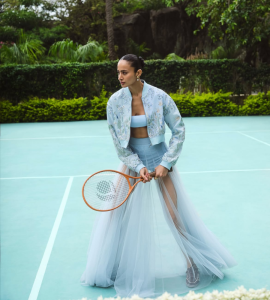
When Anita Dongre unveiled Love All, the first capsule of her Festive Winter 2026 collection, the imagery was unmistakable: a tennis court, a flower-strung net, two players facing off as equals. It was meant to be a meditation on partnership — love as a game played on level ground. Instead, it became a flashpoint for one of Indian fashion’s most persistent anxieties: who gets credit for an idea, and who gets erased.
The hullabaloo began almost instantly. Two smaller, independent fashion designers stepped forward within days of each other, each on their individual Instagram pages. In her post, Mehar Toor (Ada by Mehar) gestured to the campaign she had created in March in which she cited parallels in styling, composition and visual language. She framed it as recognition without acknowledgment, especially poignant as a smaller brand whose work had not been received with the fanfare the Dongre’s had.
Sachi Raval of Same Sisters raised a related concern. She spoke about how Same Sisters had worked on a similar theme in 2023, with the same title. But this wasn’t the issue. In Raval’s case, a member of Dongre’s team had, roughly a year earlier, solicited style references online and reportedly engaged with posts from Same Sisters’ collection. Whether that exchange shaped the campaign, Raval couldn’t say for sure — but the possibility was enough to trouble her.
Instagram users, ever eager to share their hot takes, thronged to these pages. Many called out Dongre, while a few pointed out that if you go back far enough, even the brand Jaipur Rugs followed a similar aesthetic conceit, twining tennis with fashion.
Dongre stood by her team’s work, and while acknowledging the feelings of the other designers, declined to offer an apology. Instead, she pointed out that “Tennis and fashion have shared a creative language for generations, and ‘Love All’ itself comes from that language of tennis…Rather than allowing a conversation between women-led brands become one of creative tension, I would like to acknowledge the feelings of the founders involved and congratulate them and other brands who share this space on what they have created.”
Dongre’s incident has, in fact, occurred in quick succession to another instance of the same nature. A few months back, Ila Anoop, an independent designer based in Dehradun, and a former IAF pilot accused the famed designer Sabyasachi of plagiarizing her work. Her contention was that one of the pieces from the Sabyasachi Sari Edit capsule, the saree with the 3D brooch had been inspired directly from her creation. She also claimed that a comment she had posted on one of the Instagram posts for this campaign had been removed. There is no official complaint or legal action thus far, because in both cases, the matter hasn’t gone beyond social media chitter-chatter.
None of this is new. Every few months, accusations of plagiarism within the industry fly this way and that. Equally, smaller fashion brands have been accused of lifting from established houses just as often as the reverse. Samant Chauhan was accused of echoing a jalabiya silhouette closely associated with veteran couturier Rohit Bal, a dispute that curdled into a torrid public exchange. Wendell Rodricks once accused Payal Khandwala of appropriating his pleating techniques. The irony here of course, was that these particular techniques could be cast back to Japanese designer Issey Miyake, and have since been reinterpreted by countless designers around the globe. Designers as prominent as Sabyasachi Mukherjee, Masaba Gupta, Tarun Tahiliani and Ritu Kumar have all, at various points, spoken publicly about being copied — and some have taken the fight to court and won.
What distinguishes the Dongre and Sabyasachi controversies from the Chauhan-Bal or Rodricks-Khandwala disputes is the asymmetry of power. Mehar Toor, Sachi Raval and Ila Anoop are independent, small fashion brands without the heft of the Sabyasachis and Dongres of the world.
Individually, each dispute elbows us into examining difficult questions: does anyone truly own a silhouette, a palette, or a theme if every designer is fishing in the same pool of inspiration? (One might say that tennis and fashion are a natural match.) All design has antecedents. Rajesh Pratap Singh has made more than two thousand white shirts without laying claim to the white shirt itself. Indian prints and sewing techniques circulate through craft communities long before they reach a runway. What separates inspiration from theft is sometimes just an opinion, rather than a legal issue, especially in a country where relatively few silhouettes are patented or copyrighted. This in no way takes away from the very real problems of plagiarism that afflict the industry.
What might be the way out? Perhaps an independent body capable of examining these disputes forensically? Instagram has been a tremendous democratizing force but matters of such urgency and nuance sometimes need more than outraged Instagram reels and comment sections. In an industry built on centuries of borrowing, reinterpreting, and reviving, this shared uncertainty dealt with in an honest way, might be exactly what gives Indian fashion a clearer, fairer language.



Leave a Reply