

One of Sabyasachi Mukherjee’s hottest-selling creations is the Bipasha blouse, designed for actress Bipasha Basu. Worn under a sari, it has a deep, plunging neckline and, in contrast, structured full-length sleeves. Manish Malhotra fashions blingy bikini blouses, while Gaurav Gupta is known for his structured, corset-like pieces, mostly strapless.
But this is not a piece about fashion designers. In fact, these innovative, runway-first looks have quickly made their way off the ramp and into weddings, dinners, house parties, clubs, family gatherings, and even board meetings. Even the neighbourhood designer aunty is pushing for halter-neck or backless cholis. And now they are being seen at local markets too, indicating a major societal shift.
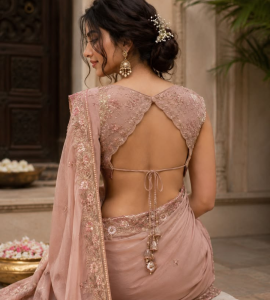
The traditional versions are often kept aside now, in favour of the readymade ikat blouses of Suta, the front-open, strappy blouses of Kalki, or even a dangerously dipping sari blouse at the local bazaar.
The blouses are becoming sexy and sensual — the stuff of couture that has main character energy. Traditionally, a blouse matched the sari — a matching piece of garment usually came with it, and it still does. But it’s the blouse that gets picked first now; the sari is styled around it.
It’s how women today are negotiating style, tradition, and sensuality. Through the blouses, they’re claiming more agency over their bodies even while draped in a traditional garment. This is how the modern blouse becomes a tool of self-expression and confidence, unconfined by conservative and regressive morals of modesty. In fact, it’s an act of defiance.
The garment itself has come a long way. If we scroll back to the pre-colonial era, there was a time when a blouse — even a petticoat, for that matter — didn’t exist. The sari was a seamless drape. It was the British who enforced the stitched upper garment as a means of modesty.
A statement blouse becomes a versatile piece that can be styled in many different ways — paired with a ghagra, a mini skirt, trousers, even a sarong, to create different looks for different occasions. There are hundreds of suggestions on the cut, pattern, and style of the blouse across the internet and social media, borrowing from Western fashion, a stranger’s grandmother’s wardrobe.
This shift isn’t happening in a vacuum. It’s the product of a generation of Indian women who have grown up with more exposure than any before them — to global fashion, thanks to fashion magazines, influencer reels on Instagram and spreads on Pinterest. Globalization didn’t just bring Western silhouettes into Indian wardrobes; it gave women a wider vocabulary for what ‘traditional’ could mean.
Social media has also collapsed the distance between the runway and real life. What Sabyasachi or Gaurav Gupta send down a red carpet gets dissected, saved, and recreated within days — not just by stylists, but by anyone with a neighborhood tailor and a Pinterest board. This democratization means a college student styling a backless choli for a friend’s wedding is participating in the same visual language as a Bollywood actress at Cannes. The blouse becomes a shared cultural moment, not a top-down trend.
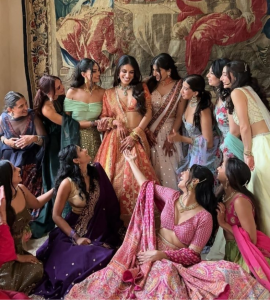
And underneath all of it is a quieter, more personal shift: women are simply more comfortable being seen. Confidence, once something to be modestly downplayed, is now something to be worn — literally, on the body. Choosing a plunging neckline or a sheer panel isn’t necessarily about being provocative; it’s about a woman deciding what she wants to show, on her own terms, rather than what’s expected of her. That’s the real modernity here — not just the cut of the blouse, but the agency behind the choice to wear it.
The daring blouse designs reflect a society moving away from conservatism — driven by an increasing number of confident women who choose to dress for self-expression rather than societal approval.



Leave a Reply