

Every so often, a film arrives that feels entirely new. But look closely, and the roots of cinematic ‘innovation’ often trace back further than the credits reveal. Cinema has always borrowed — across countries, languages, and aesthetics. Carrying echoes from one culture into another. And some of Hollywood’s most celebrated moments carry quiet fingerprints of Indian cinema.
Cinema, after all, has always been porous — images, stories, and styles travel more easily than passports. And the exchange isn’t one-way. If Hollywood blockbusters have long influenced global filmmaking, Indian cinema has quietly shaped some of Hollywood’s most iconic moments in return. The echoes are everywhere once you start looking.
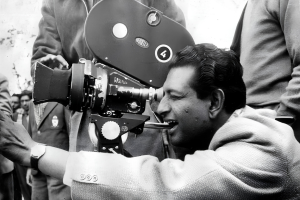
Satyajit Ray and Wes Anderson
Perhaps the strongest homage ever paid by a Western director to an Indian one was Wes Anderson’s The Darjeeling Limited. Not only does the film’s score incorporate music from multiple Ray films, its closing scene directly references Ray’s brilliant, iconic film Pather Panchali. Anderson has been quoted as saying “I also saw images of Ray, and I thought, that’s what I want to be like, if I can be like that.”
Kamal Haasan and Quentin Tarantino
In 2001, Tamil cinema released Alavandhan (also called Abhay), starring Kamal Haasan in dual roles. Among its standout sequences was a surreal animated fight, where violence was illustrated rather than shown live. Quentin Tarantino later acknowledged he had seen the film and that it inspired him to create a similar animated sequence for Kill Bill: Vol. 1 (2003)
What looked groundbreaking in Kill Bill was, in fact, part of Indian cinema’s experiments with form.
Bollywood’s Operatic Style and Baz Luhrmann
Australian director Baz Luhrmann has often described Bollywood as a creative touchstone. Moulin Rouge! (2001), his kaleidoscopic musical, drew from Bollywood’s unabashed operatic storytelling. He even used the Bollywood track “Chamma Chamma” in the film’s climactic sequence.
Later, in The Great Gatsby (2013), Luhrmann again borrowed the Bollywood sensibility of maximalist spectacle — music, colour, choreography — to heighten F. Scott Fitzgerald’s Jazz Age drama. Here, Indian cinema’s influence is not covert but celebrated: Bollywood as a blueprint for cinematic opera.
Echoes in Performance
If cinema is a conversation, then acting styles are often the most intimate language of exchange. Indian actors known for their emotional precision and restraint have left behind performances that seem to reverberate, even when no formal line of influence can be traced.
Take Naseeruddin Shah, one of the defining figures of India’s parallel cinema. In Sparsh (1980), his portrayal of a blind principal is layered with understatement — rejecting melodrama in favour of subtle gestures and interiority. In later years, critics and audiences alike have noted the resonance of such performances with international portrayals of disability, from Al Pacino in Scent of a Woman (1992) to more contemporary works. Whether Pacino ever saw Shah’s role is almost beside the point: the comparison illustrates how certain performance vocabularies travel, consciously or not, across borders. Shah himself has spoken about how Indian cinema borrows from Shakespeare and world traditions, while also offering back its own textures of realism and excess. His memoir And Then One Day reflects on this porousness of influence — the sense that no tradition exists in isolation.
Similarly, Dilip Kumar, shaped a school of acting built on poise, stillness, and reined-in intensity. His Devdas (1955) became the gold standard for romantic despair in Indian cinema, while Mughal-e-Azam (1960) showcased an imperial grandeur softened by vulnerability. Film historians often point to echoes of this style in global cinema’s most restrained biographical portrayals, such as Ben Kingsley’s Gandhi. While there’s no archival confirmation that Richard Attenborough studied Kumar directly, the comparison reflects how audiences perceive Kumar’s legacy as part of a global lexicon of gravitas and restraint.
What these examples show is less a matter of citation than circulation. Acting styles, like stories and images, move in diffuse and untraceable ways. They inspire imitation, set benchmarks, and sometimes reappear as what one critic called “cultural déjà vu” — moments when a performance feels familiar not because of direct borrowing, but because traditions are already entangled.
Beyond the Familiar Arcs
Indian cinema’s influence on Hollywood isn’t just about specific films. It’s about aesthetic sensibilities. Where Hollywood often prizes subtlety, Indian films have long balanced excess and intimacy — a song breaking into dialogue, a close-up swelling into melodrama.
That emotional elasticity has shaped how Western directors think about scale. Danny Boyle, for instance, leaned on Bollywood stylings for Slumdog Millionaire (2008), a British production suffused with Indian cinematic rhythms. Wong Kar-wai, though not Hollywood, has credited Bollywood’s emotional sweep as a cinematic parallel in Asia.

Even the global fascination with song-driven narrative owes something to Indian cinema, which normalized music as plot, not ornament, long before Hollywood musicals revived the form.
Today, Indian films are festival staples, Oscar winners, and global streamer hits. The success of RRR at the Academy Awards, Payal Kapadia’s All We Imagine as Light at Cannes, and Indian thrillers on Netflix mark a new visibility. But the truth is, influence has been here all along — quieter, less credited, yet deeply woven into Hollywood’s fabric.
As global audiences increasingly look outside the West for inspiration, it’s worth recognizing that Indian cinema has been a quiet source. Cinema has never been a closed loop. The reels spool across borders, carrying echoes of Kolkata, Chennai and Mumbai, into Los Angeles and back again.




Leave a Reply