

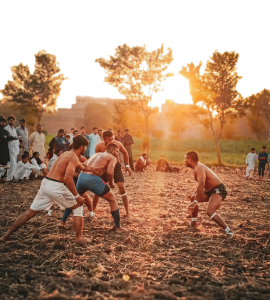
There is a version of this story that begins thousands of years ago, in the villages of Southern India, where young men squared off on bare patches of dirt with no ball, no bat, no net — only the chant ‘kabaddi kabaddi kabaddi’ and their nerve. One side sent a single raider across a line scratched into the earth. Their job was to tap as many opponents as they could and sprint home again, all on a single held breath. If his breath ran out before he did, he was out of the game. Some tellers of the old epics even find a version of it in the Mahabharata, where the warrior Abhimanyu (Lord Arjuna’s son) stands alone against a ring of enemies.
For most of its long life, kabaddi was dismissed as a village game, a school child’s game, an evening pastime, not to be taken seriously in the way cricket was. It asked for no equipment and no money, which is precisely why it never accumulated any. Hockey had its Olympic gold medals; cricket, eventually, had everything else. Kabaddi had a patch of dirt. Baffling, since it was popular around Asia; known as hu-tu-tu in western India, ha-du-du in eastern India and Bangladesh (where it is the national sport), chedu-gudu in southern India, gudu in Sri Lanka, and theechub in Thailand.
The first hint that the game might mean something bigger came via an exhibition bout at the 1936 Berlin Olympics, although it was looked upon as a mere curiosity. It took until 1950 for the sport to acquire even the skeleton of an institution, with the founding of the All India Kabaddi Federation, and another forty years before the Asian Games, in 1990, admitted it as a medal sport for men. For women, it took another twenty years.
Then, in 2014, something changed with the birth of the Pro Kabaddi League. It borrowed its entire architecture from the Indian Premier League, cricket’s glittering, massively popular franchise. Out went the packed-dirt fields; in came air-conditioned arenas, ringed by disco lights and blaring film music. Out went matches that could stretch on indefinitely; in came forty-minute contests, sharpened by rules like the “do-or-die raid” and the “super tackle,” built for a television audience with no patience for slowness. The raider’s chant, the very thing that made the sport what it was, got replaced in the professional game by an overhead clock counting down thirty seconds — efficiency triumphing, as it usually does, over ritual.
It worked. Within a few seasons the league had rocketed to become India’s second most-watched sporting product, trailing only the IPL itself, drawing crowds that dwarfed anything hockey or Indian football had managed. Steel magnates and Bollywood stars bought franchises; the actor Abhishek Bachchan took the Jaipur Pink Panthers, while his father, Bollywood icon Amitabh Bachchan, lent the whole enterprise his considerable shine. Players who might once have spent their careers in obscure local leagues were suddenly the subject of televized auctions, bid up into small fortunes.
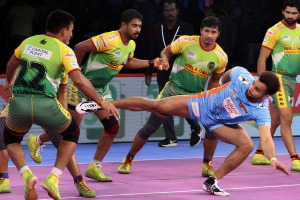
What is easy to miss, amid the sponsorship money and the strobe lighting, is that the league never quite let go of its origins even as it dressed them up for the cameras. Every franchise is required to carry foreign players — Iranians, mostly, since Iran has produced some of the sport’s finest defenders, but also Koreans, Japanese, Turkmen, even Britons. It is a small, almost bureaucratic requirement, but it has quietly managed to send the game abroad, player by player, franchise by franchise.
In the last couple of years, that quiet trickle has become a stream. A World Cup, staged for the first time outside Asia, unfolded across Birmingham, Coventry, Walsall, and Wolverhampton, with sixteen men’s teams and eight women’s, England taking on Cameroon, and Sri Lanka, China, and Egypt as well. Broadcasts on BBC iPlayer carried the whole affair to an audience that had never heard the raider’s chant. Officials speak hopefully, as officials do, of the Olympics one day — though India’s own record at the Asian Games, where it has recently finished behind both Iran and South Korea, suggests that global popularity and Indian dominance may not be the same prize.
What began as a way for village boys to test their lungs and their courage has become, however improbably, a piece of glittering export. It is proof, if any were needed, that even the oldest and simplest games can be taught new tricks, and made to travel.




Leave a Reply