

In the desert city of Jodhpur, architect A Mridul and his team are restoring the early-18th C Mahamandir stepwell. It is 150 feet deep and sits at the heart of an old Jaipuri neighborhood. Thousands of miles away, in Portugal’s beach town Melides, a circular structure resembling these ancient stepwells, has been making the news. It is the work of Egyptian architect Tarek Shamma, who designed it as a space for gathering and retreat, in the home of fashion designer Christian Louboutin.
Both India and the West have developed a fresh interest in these water reservoirs built hundreds of years ago. Their ingenious architecture spotlights them as a crucial climate crisis solution. These bavdis or vav, as they are called, store rainwater all year round. The steps, running up and down all around the water, make it possible for people to reach the source even when water recedes during the summer. Made with locally-available stone and lime, stepwells are the original ‘cooling centers’ or ‘climate centers’. The water and the built-in sheltered balconies provide respite from scorching heat.
It’s why state governments, local communities and NGOs are restoring these ancient structures that have been ignored for far too long. Many of them had been reduced to dumping yards, explains Mahendra Singh Tanwar, convenor of Jodhpur’s INTACH (Indian National Trust for Art and Cultural Heritage) chapter. The not-for-profit organization has initiated several stepwell restoration projects in the city over the last two decades.
And the restored stepwells are now brimming with water. Hospitality and tour companies are promoting these as tourism and event hotspots. From music performances to poetry readings, these stepwells are buzzing with people again. Jodhpur has included a few of these in its city tours, and has a dedicated stepwell walk too, facilitated by INTACH. “Tourism and events help fund the upkeep of the conserved stepwells, which, in turn, generate employment for the locals,” says Tanwar. “It’s a great incentive for communities to take ownership of these structures and not let them fall into ruin again,” adds Tanwar.
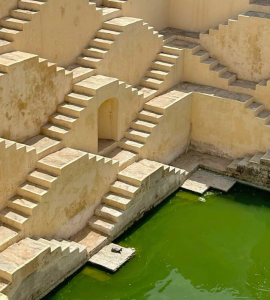
The international design world is taking notice too. Italy-based CC Tapis launched a line of rugs inspired by stepwells two years ago. Then there is the monumental Vessel at Hudson Yards, in New York City. The $150-million public monument designed by Thomas Heatherwick was structurally inspired by stepwells too. Stefano Ricci recently shot his Spring/Summer 2026 campaign at the Panna Meena stepwell in Jaipur. “The inverted pyramid geometry and optical illusion of stepwells fascinate designers,” explains Mridul.
Stepwells in India are not just in Rajasthan. They are also found in Punjab, Haryana, UP, Maharashtra, and Telangana, and those are being restored too. These too have always functioned as social sites where people gathered, especially women when they came here to fetch water. Pujas and cultural festivals were held here too.
Even historically, these structures were the combined responsibility of the administration and the people. While the elaborately carved ones were commissioned by kings, queens and rich traders, the smaller and humbler-looking ones were funded by different communities by pooling together contributions from multiple people.
“The social use of these structures makes these water reservoirs unique among other such ancient water storage solutions around the world,” says Mridul, who has worked on many stepwell conservation projects in Jodhpur. He has also built the Birkha Bawari inside the private Umaid Heritage Housing Township in Jodhpur. Completed in 2009, this 21st-century stepwell spans 224 metres in length and can hold over 17.5 million litres of water to supply the housing complex. It was built with red sandstone and traditional masonry techniques without any cement or concrete.
Perhaps the most difficult aspect for many international audiences to grasp is that these reservoirs once supplied drinking water. “People are often surprised that communities consumed stored, untreated water,” says Mridul, who has presented his work on stepwell conservation at universities including Harvard and MIT. “But they did. The layers of stone acted as natural filters.”
As cities around the world search for ways to adapt to rising temperatures, water scarcity and increasingly erratic rainfall, stepwells offer a reminder that sustainable solutions do not always need to be invented from scratch. Sometimes they are hidden in plain sight, carved deep into the earth centuries ago, waiting to be rediscovered.





Leave a Reply