

We’re seeing them everywhere. Videos and photographs of Christopher Nolan, Matt Damon, and Timothée Chalamet dressed up in suits, and having cutting chai and bun maska in Mumbai’s iconic Olympia Coffee House.
This was no casual chai stop. Instead, it was a pre-planned part of the publicity for the freshly-released film Odyssey. Universal Pictures India shared the moment on their Instagram page, captioning it “Quick tea stop before ‘The Odyssey’ Mumbai Premiere. A big night awaits, but chai comes first.” This, predictably enough, went viral in Mumbai. Even just a decade ago, such Hollywood promotions in India were rare. Is this a sign of the changing times?
But before you make up your mind, let’s review all the evidence. The incontrovertible fact is that there has been a sudden rocketing in South Asian representation across the entertainment board. That’s why we suddenly see Alia Bhatt posing on the red carpet in Cannes; Maitreyi Ramakrishnan (of the Netflix show Never Have I Ever) cast in the Legally Blonde prequel Elle, and Sarita Choudhury cast as Carrie’s best friend in And Just Like That, the Sex and the City sequel.
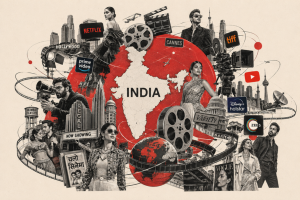
And here’s another piece of evidence: a whole host of streaming platforms – Amazon Prime, Netflix, Disney-Hotstar and SonyLIV – are giving away free memberships in India via Airtel.
So does this mean that India is now being recognised as a significant theatrical market? Does India now wield soft power that it never had before? Or is it all just tokenism for views and clicks?
India’s presence in Hollywood films has rarely gone beyond a supporting role. There are exceptions of course, Priyanka Chopra being the biggest one. Bridgerton (Season 2, 2022) introduced the Sharma sisters, a rare moment where South Asian characters were given central roles in a period drama. Kumail Nanjiani has been nominated for everything from an Academy Award and Golden Globe Award, to the Emmy Awards. But by and large, India and Indians existed as colorful caricature or as a sidekick.

If you reduce a culture to backdrop often enough, its own people may start seeing it as something to outgrow rather than embrace. This shaped more than outsiders’ perceptions of us — it began to shape our own.
On the other hand, Hollywood has always absorbed and sought out whatever cultures are commercially useful. Italian-American culture, stylish Japanese aesthetics, Latin music, Korean entertainment, and now increasingly India too appears to be part of the conversation.
But real representation asks harder questions. Who’s writing the stories? Who’s directing them? Who’s behind the camera, in the boardroom, in the editorial meeting? It also asks what stories are being told and which ones are being left out.
Undeniably, global institutions increasingly feel compelled to engage with India directly. Hollywood stars come to Mumbai. Luxury brands launch campaigns around Indian consumers. Streaming platforms compete aggressively for Indian audiences. International productions cast South Asian actors not as exceptions but as commercially sensible choices. These are signs that India is becoming harder to treat as peripheral.
The more important question is whether this visibility evolves into authorship. Soft power is meaningful not just when three Hollywood stars pop into a Mumbai restaurant, but when Indian creators increasingly shape the stories, images, and narratives that the rest of the world consumes. That’s the true transition from being a market to being a cultural force.
So are the Olympia Coffee House photographs evidence of soft power or tokenism?
Probably both.
The tokenism exists because India matters. If India were irrelevant, nobody would bother performing cultural familiarity in the first place. But the existence of tokenism also reveals the limits of the current moment. Chai with movie stars makes for a compelling photograph; it does not necessarily signal a deeper engagement with Indian realities.
And that may be the real shift underway. India is no longer simply being looked at. It is becoming too large—economically, culturally, and demographically—to be ignored. The challenge now is ensuring that visibility translates into influence, and that influence into the power to tell its own stories rather than merely appear in someone else’s.




Leave a Reply