

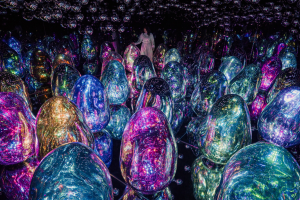
They’re probably seven or eight, the two little girls who are running across the floor, bursting the mist-filled bubbles that descend slowly from a towering, aluminium tree. After a little while, their mothers join them, interacting with A.A. Murakami’s (Azusa Murakami and Alexander Groves) artwork New Spring. The work perfectly recreates the fleeting beauty of cherry blossoms with the help of digital-tech.
Nine such works of art are featured in Second Nature, an exhibition that explores humanity’s relationship with the environment. Housed at Mumbai’s Nita Mukesh Ambani Cultural Centre (NMACC) for six months, it is powered by motion sensors, responsive lights and sound, as well as digital printers. Naturally, it’s gone viral on Instagram and YouTube.
From Qatar to Singapore, Tokyo to Zurich, digital and AI art exhibitions are fast gaining popularity among tourists and locals. While digital art is enabled by tech, AI art is created by artificial intelligence with prompts from the artists.
And both are criticized for creating a spectacle that overshadows the purpose of art itself. It’s gimmicky, simulative, and meant to please social media. Some have even gone as far as calling it slop. Also, like anything AI, the art is condemned for copying or borrowing from copyrighted works, without giving their creators any credit or compensation.
Yet, both artists and viewers are drawn to it. Artist Refik Anadol and wife Efsun Erkiliç opened Dataland in Los Angeles, the world’s first permanent AI museum. Dubai has announced one too. Japan-based teamLab, famed for its immersive digital light installations (also showing at NMACC), is building its second permanent space in Singapore soon.
Digital and AI art have democratized both art making and art viewing. Anyone with a great idea can create art now. Besides, “viewers are drawn in with its easy access, and because it responds to them,” says Mollie Dent-Brocklehurst, curator of Second Nature and the co-founder of Miami-based Superblue, a 50,000-sq-ft space of immersive art. In a country like India, where the art-viewing or museum-going culture is still negligible, the spectacle of AI art becomes a big motivating factor for people to get out of their houses and into art galleries.
Outside of the few public museums and a handful of private museums, art viewing in the country has largely been an intimidating experience. The jargon-heavy wall texts, the exclusive, invite-only wine-and-cheese openings, the posh, Anglophile art world, and frequent references to Western art theories, have made it inaccessible for the majority.
Even today, if you visit a private gallery on weekdays, most times, you’ll be on your own. There won’t be anyone to walk you through the work or hand you reading material. It’s hard then to feel connected with that static painting on the wall. Whereas the immersive digital and AI works don’t alienate you. They don’t make you feel small or foolish, even if you haven’t studied art history. Instead, they respond to you, literally — Random International’s Presence and Erasure at Second Nature prints the images of onlookers on a photochromatic surface.
Plus, such art offers a different experience each time you view it. Artists and curators Jiten Thukral and Samir Tagra invited Zambian artist and writer Bwanga Kapumpa to showcase his AI art project Dr Bwanga at Goa’s Serendipity Arts Festival last year. Kampupa trained an AI chatbot to counsel viewers based on his research on Zambia’s traditional healers. A viewer would enter a traditional telephone booth, voice their anxiety or ask a question and the chatbot would answer. Because the algorithm was trained to push machine learning, many participants found the responses eerily accurate and therapeutic. So, they would try it over and over again.
These works are pushing the boundaries of how we experience art. At Dataland, viewers are given a box of chocolate that give you the taste and smell of different parts of a rain forest. Created in collaboration with Valerie Confections, these chocolates are physically shaped by data.
The textures, geometric patterns, and molds of the chocolates represent visual data maps generated directly by machine intelligence. Each comes with a distinct smell and taste that is intended for the viewer to touch and taste different parts of a rainforest, not just see and hear it.
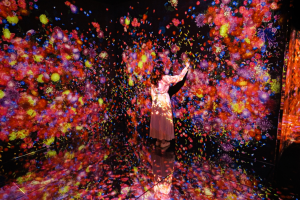
“AI art is here to stay whether you like it or not,” says Dent-Brocklehurst. After all, it has enabled artists to realise some of the most ambitious projects that would otherwise just remain in their imagination. Perhaps then the measure of these works is not whether they satisfy critics, but whether they spark curiosity. Judging by the two little girls chasing bubbles through New Spring—and the adults who eventually joined them—they already have.



Leave a Reply