

At first glance, there’s nothing remarkable about the matchboxes you can find in India today. Most are faded yellow, with names like Ship, Cycle, or Homelite stamped on them in bold, blocky type. They’re everywhere — in kitchen drawers, corner shops, street stalls. Functional but forgettable.
Today, we might not realize it, but there once was a time when matchboxes were the tiniest canvases of art. Packed with personality, their art featured everything from roaring tigers to glamorous film stars, from gods and goddesses, to tractors and tea kettles. Some labels carried political messages, others leaned into pop culture, and many simply leaned on oddball charm to stand out on crowded paan-shop shelves.
Long before India began producing its own matchboxes, we brought them in from faraway places — Sweden, Austria, Czechoslovakia. These imports weren’t just practical; they were works of art, but their aesthetic, like their clientele, was European.
This changed in 1895, when Kolkata and Tamil Nadu began to manufacture homegrown versions. And once these Indian factories took over matchbox production, something interesting happened: the designs became louder, cheekier, and unmistakably Indian — with tractors, temple bells, tigers, film stars and even courtesans, crowding the covers.
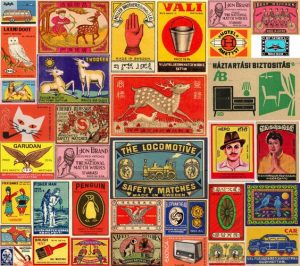
“Some portraits often showed Maharajas on horseback or their official portraits and because of the attention generated by these images, the rulers of states like Jamnagar, Bhavnagar and Cochin reproduced their own customized versions of the matchboxes for personal use,” says Ramya Ramamurthy, author of Branded in History. “The royals of the time were like the influencers of their era – they were emulated for their style, their images sold products and their matchboxes became collectibles.”
But the designs weren’t simply decorative in nature; in fact, they told the tale of their times. For instance, the boxes born during the Freedom struggle told a most interesting story.
“The factories that could get away with making more overtly political matchbox covers featured Bhagat Singh, Mahatma Gandhi, Subhash Chandra Bose or Sarojini Naidu,” says Ramamurthy. “In fact, Gandhi became a whole sub-genre of matchboxes – featuring his wife Kasturba, his ashram in Sabarmati, his famous Gandhi cap and even a brand of matches in his name. The spinning wheel or charkha was another prominent theme in matchboxes. The map of the emerging India freeing itself from the shackles of colonialism was another important theme – the personification of this as Bharatmata or Hindmata – reclining on an elephant, tiger or a similar Indian animal was seen as a common trend.”
Later, during the agricultural Green Revolution, tractor and farmer imagery abounded. In the 1950s, Bollywood stars began to appear. What began as everyday ephemera became an archive of shifting styles, politics, and pop-cultural moments – in short, the rhythms of daily life. “This is eventually what made phillumeny or the collection of all things related to matches and matchboxes so interesting because it was a record of the companies of the era, an advertising and design journal as well as a record of the impressionable iconography of the time,” explains Ramamurthy.
At one point, you could spot everything from Ganesha to Michael Jackson — symbols of luck, fame, or aspiration. The artwork was also often recycled: a tiger drawn for one brand could easily show up on another, with a new name slapped on top. It was less about copyright, more about circulation.
Alas, today, many of those wild, colorful designs have given way to QR codes and cleaner packaging. So what happened?
Part of the shift is economic. As large-scale manufacturers replaced cottage industries, the focus moved to mass production, uniformity, and cost-cutting. A single printer might now churn out hundreds of thousands of identical boxes, designed more for efficiency than flair. Matchbox production itself has declined somewhat; beedi and cigarette users were amongst the highest users in contemporary India and their numbers have nosedived.
The other part is cultural. Visual storytelling has migrated online, to Instagram and YouTube thumbnails. Branding, even at the paan-shop level, has become slicker, more global. Logos are cleaner, colours more muted, and everything’s ready to be scanned, posted, or shared.
And yet, a love for these old designs persists. You’ll find matchbox labels being repurposed into coasters, art prints, even saree borders. On Instagram, collectors are scanning and trading old matchbox labels like rare baseball cards. ArtonaBox, Shreya Katuri’s Instagram page, documents matchboxes from around the world. Cafés in Mumbai and Delhi display framed collages of vintage labels. Artists are reprinting old designs onto notebooks and tote bags.

They are also sparking other conversations. Maachis Art is reviving these tiny canvases into beautiful collectibles (there are T-shirts and postcards too); the viral sneaker brand Comet created a vibrant matchbox-inspired shoe called Maachis; the artist Harshit Agrawal, together with Google Arts & Culture and Tasveer Ghar, has created an interactive matchbox game. At The Maachis Project, Aakansha Kukreja and Aakash Doshi are repurposing old covers into graphic art. In a culture tired of minimalism and slick branding, these little boxes feel refreshing — chaotic, charming, and definitely unpolished.
It’s not just in India. In Japan, there’s a niche but devoted community of match label collectors. In Scandinavia, an entire museum is dedicated to preserving these tiny designs. Across the world, there’s a growing appetite for affordable, tactile nostalgia — small objects that carry weight, history, and memory. They’ve gone from mass object to aesthetic artifact — a reminder that even the most disposable things can hold stories, humour, and history.




Leave a Reply