

Think about the last time you imagined a city of the future. There were probably towers, glass and steel, screens embedded in surfaces, a sky interrupted by elevated transit, and neon bleeding into wet pavement at night. The scale was vertical. The palette was dark or cold or both. Almost certainly, it did not look like anywhere you actually live.
One way to understand this convergence is through what the psychologist Joseph Henrich calls prestige-biased cultural learning, the human tendency to copy the behaviors and styles of people and institutions that appear successful rather than evaluating each choice from first principles. “At an individual level, this is efficient,” says Kavita M, a Delhi-based counsellor who studies cultural psychology. “At a cultural scale, it produces convergence.” Countries and industries imitate perceived leaders, and over time those borrowed choices begin to reinforce one another.
“That is why financial districts around the world feature broadly similar towers, and why the visual language of economic power has become so standardized that you can often identify a building’s function before you can identify its country,” says Anurag T, a Delhi-based architect. Science fiction, in this reading, simply extrapolates that convergence to its imagined endpoint, mistaking a historical tendency for an inevitability.
Architecture has always been one of the clearest ways that power makes itself legible. The historian Thomas Metcalfe, writing about the British Raj, observed that the public buildings erected under colonial rule were charged with the explicit purpose of representing empire itself. The architecture was intended to make imperial authority visible and durable, turning the built environment into a statement of political power.
Similar dynamics appeared elsewhere, where centralized authority used architecture to project legitimacy and permanence. Science fiction inherited this association almost without noticing. When a story needs to depict an all-powerful state or corporation, it reaches instinctively for visual sameness, rows of identical towers, anonymous crowds, reflective surfaces that express nothing beyond scale. The dystopia looks the way it does because audiences have learned, through long familiarity with how power presents itself, to read visual uniformity as control.
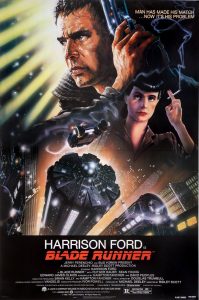
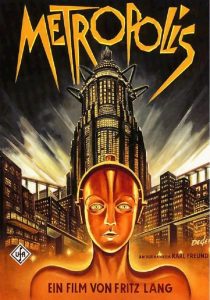
That reading has a specific cinematic genealogy. In 1982, Ridley Scott’s Blade Runner drew its visual grammar from Hong Kong’s neon-lit commercial districts, Fritz Lang’s 1927 Metropolis, and the work of Syd Mead, the film’s credited visual futurist, who described his approach as layering new technology onto the accumulated wear of a city that could no longer afford to replace itself.
The film failed at the box office and became one of the most influential things ever put on screen. William Gibson, whose novel Neuromancer would help define the cyberpunk genre the following year, told The Paris Review in 2011 that he had avoided watching Blade Runner in theaters because he feared it would be better than what he had imagined. It was, he said, and even the first few minutes were better.
In one important sense, Blade Runner did more than imagine a future. It gave other filmmakers a visual language they no longer had to build from scratch. By 1988, Katsuhiro Otomo’s Akira had extended that language into anime, building Neo-Tokyo from neon and rubble and towers so tall they required a thousand floors to feel proportionate to the dread the story needed. Ghost in the Shell followed in 1995, its director Mamoru Oshii drawing on Hong Kong’s layered urban landscape to imagine a city where the past and the technological future occupied the same streets simultaneously. By the time The Matrix arrived in 1999, the grammar was so established that it functioned as shorthand, legible without explanation to audiences who had absorbed it across two decades of film without necessarily knowing they had.
The images became the genre, and the genre became, for many people, the template for what the future was supposed to look like. Which is why what Hannah Beachler did for Black Panther in 2018 registers as more than a production design achievement.

Beachler spent eight months traveling across sub-Saharan Africa before she began designing Wakanda. She compiled a 515-page document she called the Wakanda Bible, detailing the architecture, topography, textiles, languages, and cultural logic of a fictional African nation that had never been colonized and had therefore developed entirely on its own terms. What she was practicing, deliberately and with considerable research behind it, was Afrofuturism, a movement that asks what African and diasporic cultures would have built, imagined, and become in the absence of the history that was actually imposed on them. The result was a future city that looked genuinely unlike most previously imagined ones, curved rather than angular, warm in its materials, drawing on rondavel rooflines, Zaha Hadid‘s fluid structures, and textile traditions from across the continent.
Audiences responded with something that looked as much like relief as admiration. Beachler became the first African American to win the Academy Award for Best Production Design. The question worth asking is whether that response pointed to something the dominance of the cyberpunk aesthetic tends to obscure. The generic sci-fi city is not a reflection of universal human intuitions about what progress looks like. That is difficult to square with the diversity of ways in which different cultures have imagined technology, cities, and social life. Instead, it reflects which stories got made, by whom, with whose resources, and whose existing imagery they drew from.
It became the default because those particular films were seen everywhere and their influence compounded, not because they captured something true about where all of us are headed. When we imagine the future, we imagine it from somewhere. That somewhere shapes everything, from the scale of the buildings and the logic of the streets to whether density reads as vitality or danger, whether ornament signals care or excess, and whether the future feels like it belongs to everyone. We have simply mistaken one visual language for the future itself.




Leave a Reply