

The 2026 FIFA World Cup is unfolding across sixteen stadiums in three countries. None of those venues was built for the tournament. Once the final whistle blows, they will return to hosting league matches, concerts, and other live events, a reminder that the modern stadium has become something much larger than a home for sport.
The idea that stadiums exist primarily to host sports is becoming harder to defend. The buildings still bear the names of teams, and the teams still play inside them. But the financial logic driving billions of dollars in stadium construction and renovation is no longer organized around the ninety minutes on the pitch or the three hours on the field. It is organized around everything that happens before, after, and between games.
A June 2026 report from Addleshaw Goddard, a law firm that advises on major venue developments across Europe and North America, found that more than 300 stadium construction and renovation projects began globally in 2025. It also reported that European clubs that own their stadiums derive 76 percent of their commercial revenue from non-matchday activity, according to Estates Gazette’s coverage of the research. Hotels, conference centers, restaurants, concerts, corporate events, and weddings have all become part of the business model. Sport increasingly serves as the anchor tenant of a much larger enterprise.
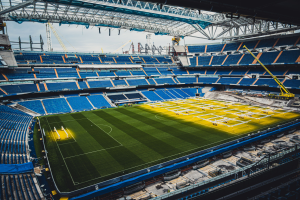
This shift has been building for years, but several trends have accelerated it. Television revenue, once considered the industry’s most dependable income stream, has become less predictable as streaming fragments audiences and media rights negotiations grow more complex. Construction costs have climbed sharply, making it difficult to justify venues that sit empty for most of the year. The result is a stadium designed to stay busy, one that functions as an entertainment destination rather than a building that opens only on game day.
The question worth asking is why this model has become so compelling at a moment when almost everything a stadium once monopolized, watching a match, listening to music, or following a team, can be experienced from a screen at home. The answer may lie in the one thing digital life still struggles to reproduce, the feeling of being there.
Tottenham Hotspur Stadium offers one illustration. Built with a retractable grass pitch and a synthetic surface beneath it, the venue can switch from Premier League football to NFL games in roughly a day and has also become one of London’s busiest concert venues. SoFi Stadium in Los Angeles, one of this summer’s World Cup hosts, sits at the center of the 300 acre Hollywood Park development, alongside apartments, retail, hospitality, and entertainment spaces. The stadium itself hosts only a limited number of NFL games each year, but it is active far more often than that. Beyoncé performed five nights there in May.
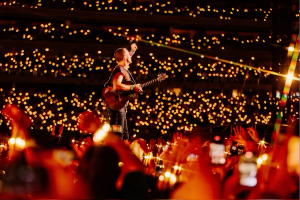
A similar pattern is visible in India. Coldplay’s two January 2025 concerts at the Narendra Modi Stadium in Ahmedabad drew more than 220,000 attendees and generated an estimated ₹641 crore in economic impact for the city, underscoring the growing role of large venues as year-round entertainment destinations.
The concert business helps explain why. Pollstar reported that average gross revenue from stadium concerts reached $7.11 million per show in 2025, up 19 percent from the previous year, while average ticket prices rose 18 percent. Taylor Swift’s Eras Tour became the highest grossing tour on record. Those figures illustrate why developers continue investing in venues that can accommodate music, festivals, and other large gatherings alongside sport.
Demand for live experiences appears to be growing as well. Eventbrite’s 2026 Social Study, surveying adults aged 18 to 35 in the United States and Britain, found that 79 percent planned to attend more live events than they had the previous year. People are paying for more than the match or the concert itself. They are paying to occupy the same physical space as thousands of strangers reacting in real time, an experience that remains difficult to replicate online.
The World Cup itself fits neatly into that logic. FIFA did not require a fleet of newly built arenas. It relied on existing venues that could be upgraded to tournament standards and continue generating revenue long after the competition ends. Renovations across the host stadiums are expected to leave behind infrastructure that supports concerts, conventions, and other events for years to come, extending the commercial life of each building well beyond football.
The model is not without tradeoffs. Ticket prices have risen steadily across many major leagues, making attendance less accessible for some supporters. Economists have long questioned whether public subsidies for stadium projects deliver returns that justify their cost, and local businesses can lose foot traffic when visitors spend their time and money inside integrated entertainment districts rather than in surrounding neighborhoods.
There is also a cultural cost that is harder to quantify. For generations, stadiums brought together people who might otherwise have had little in common beyond allegiance to a team. They stood in the same queues, sat in the same sections, and reacted together. Premium clubs, private lounges, and hospitality suites do not eliminate that atmosphere, but they redistribute it across different tiers of access.
Researchers and designers have long argued that densely packed supporter sections contribute meaningfully to the character of a match. Borussia Dortmund’s Yellow Wall, one of football’s most famous standing sections, is often cited as evidence that architecture shapes atmosphere as much as the game itself. Clubs understand this. Even as hospitality expands, many preserve vocal supporter areas because they remain essential to the experience the venue is selling.
What is emerging in city after city is a different kind of civic space, one built to host concerts, conferences, festivals, restaurants, and football in equal measure, and to remain active throughout the year. In an increasingly digital world, developers are making a remarkably consistent bet that people will continue to place value on gathering in person, and will keep paying for places that make those gatherings possible.




Leave a Reply