

This article was written out of frustration. A frustration born from the fact that even in 2026, discussions of genre fiction still focus on Western authors. Indian science fiction is superb – and yet it is too often ignored or entirely undiscovered.
Why this sniff of stigma? Why are we thumbing past some of the country’s best writing?
A possible reason might be that for many readers, the entire spectrum of such literature — fantasy, science fiction, speculative, whichever lens you may choose — is condensed into some sort of escapist writing, far too unrelatable and therefore incomprehensible to the ‘average’ reader. “It’s just too out there for me,” says Shrila Basu, the author’s friend who recently finished a 900-page tome of historical fiction set in a country she has never visited.
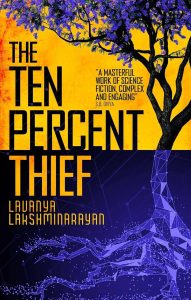
And yet. Samit Basu’s recent short story What Would Akanda Do? Grapples with the afterthoughts of a Bollywood star who has signed away his likeness to AI, while his debut book, The Simoqin Prophecies, was marketed as ‘Monty Python meets the Ramayana’. Indrapramit Das’s novel The Last Dragoners of Bowbazar is set in a very recognizable Kolkata. And Lavanya Lakshminarayan’s The Ten Percent Thief grapples with questions of systemic caste inequity. All these themes have an immediate resonance for readers in India — albeit refracted through the lens of completely different universes.

So why is Indian speculative fiction still struggling to get a foothold, in India and internationally?
Lakshminarayan, in a phone conversation with The Moment suggests that in India, readers are possessed of a sort of inverted snobbery, in which non-fiction books are pinnacled as the pursuit of self-improvement, while the universe of the imagination is often trivialized.
The only exception might be mythology; writers like Devdutt Patnaik and Amish Tripathi, as well as comic books such as Amar Chitra Katha tap into stories that feel like a part of living tradition, rather than something removed from reality. No wonder then that Bollywood star Ranveer Singh has acquired the rights to play Lord Shiva in the film adaptation of Tripathi’s The Immortals of Meluha.
Both mythology and science fiction create fantastical worlds; but the one remains faith-based, while the other is steeped in science. For Indian readers then, these templates of genre are walled into place, making it tougher for fantasy or science fiction to reach bookshelves around the country. In the enormous mosaic of the publishing world, the fractured attention economy makes discovering great Indian books really hard.
An anonymous source within Indian publishing circles gave an even grayer reading of the situation. “Part of it is that there are simply not enough people who want to read works in English. Even fewer who want to read literary works in English. And even fewer who want to read work in English emerging from India.” For genre fiction, they added, “readers mostly look West for their cues on what to read — so it tends to be much lower on Indian publishers’ priorities.”
Perhaps it all comes down to the matter of marketing muscle.
Marketing in India, no matter how robust, cannot quite harness the extraordinary talent of genre fiction in the way international marketing ecosystems can. And so, to discover speculative fiction, a reader (wherever in the world he is) must spade through shelves of George R. R. Martin and Sara J Maas, before arriving — if they arrive at all — at writers from Goa or Kolkata.
“I have worked with excellent publishers in India,” Lakshminarayan says, “but no matter what we do over here, we absolutely cannot compete with the next big Sally Rooney.”
Industry insiders suggest that almost everywhere in the world, such literary fiction retains an aura of prestige that ‘genre’ fiction still grasps at. This aura is unsullied by the problems of profitability; apparently most literary writing does not even recoup its advance. Yet publishers press on, sending such books to national and international book lists, book clubs and literary festivals. This might be one reason why, in the international publishing world, Indian writing in English is largely associated with Kiran Desai or Arundhati Roy.
Sadly, “Indian readers are sometimes even slower to discover our books,” says Lakshminarayan. And when they do discover them, they are often surprised that the writer is based in India at all.
That irony is compounded by a broader amnesia about India’s own speculative tradition. For instance, Rokeya Shekhawat Hussain’s Sultana’s Dream — a visionary feminist utopia published in 1905 — was groundbreaking not just for its own time, but even for ours. Besides, regional writing in Bengali and Malayalam have long harbored currents of speculative storytelling.
But change is certainly underfoot.
Writers like Indrapramit Das, Tashan Mehta, Samit Basu, and Lavanya Lakshminarayan are building vividly-inked worlds as eerily accessible as they are fantastical, rooted in Indian realities even when they are set in distant futures or sideways presents. Publishers are urging them on — Bloomsbury’s excellent (albeit clunkily-named) anthology Post-Millennial Indian Speculative Fiction in English being a case in point.
There are prizes galore. Samit Basu’s The City Inside was named one of the best sci-fi/fantasy novels of 2022 by The Washington Post and Book Riot. Indra Das won the Best Novella category at the 2024 British Fantasy Award for The Last Dragoners of Bowbazar. Lavanya Lakshminarayan is the first science fiction writer to win the Times of India AutHer Award and the Valley of Words Award, and the first Indian woman to be nominated for the Arthur C. Clarke Award (in 2024) for The Ten Percent Thief. Tashan Mehta won the Best Fiction award at the AutHer awards.
What is missing is the ecosystem to sustain them — the readers, the publishers, the critical culture that would allow Indian speculative fiction to become, as it deserves to be, a central strand of Indian literary life rather than a footnote.





Leave a Reply