

Before it was played under bright Olympic lights or became a backyard staple in British country homes, badminton had a very different name: Poona.
In the 1860s, British army officers stationed in Pune (then Poona) stumbled upon a curious game that locals were playing — one that involved woolen balls, wooden rackets, and boundless improvisation. Some say its roots lie even further south, in Tamil Nadu, where a version was played with a soft ball made of thread or wool. And in the UK, people believe its origins lie in the ancient games of battledore and shuttlecock, versions of which were played all over Europe and Asia.
The British, already accustomed to tennis and lawn tennis, took the Indian game, added a net, created different rules, and carried it back to England. It is believed that army officers, returning from India perhaps, played a version of this sport at Badminton House in south Gloucestershire, and this likely gave the sport its name.
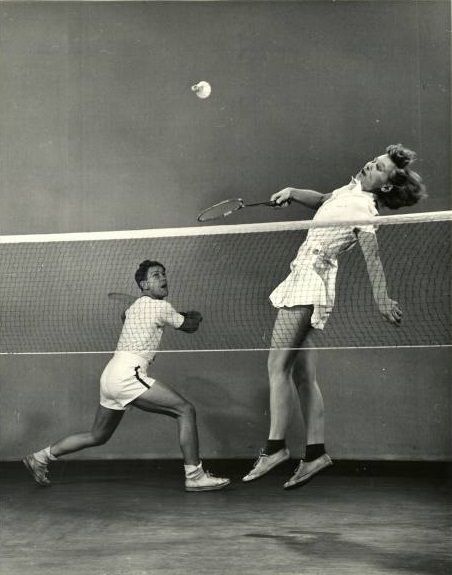
That origin story reveals how play travels across borders and classes and castes, mutating and adapting as it goes. Even the ‘Poona game’, as it was initially called in British circles, wasn’t a monolith. People in Shimla played it differently than those in Calcutta or Bombay. Karachi had its own spin. In southern India, purportedly in Thanjavur, there was the equally well-regarded Ball Badminton, a separate version played with a soft ball. Up until the 1960s, this version was so popular that players had to specify which kind of badminton they played – ball or shuttle! There is even a Ball Badminton Federation of India today!
In fact, so deeply entrenched was badminton that luxurious British homes across colonial India boasted of badminton courts — ‘12 acres of well-wooded grounds, including Tennis and Badminton Courts’ bragged an 1899 advertisement for ‘The Park’ in Shimla – as did posh ladies’ clubs and gymkhanas. It was played by both men and women — a rare instance of accessible, gender-neutral recreation in colonial India. Certainly, this badminton-mania continued even after Independence from the British, with the Indian newspaper, The Bombay Chronicle, even hiring its own badminton correspondent to cover the sport.
Fast forward to today, and India has produced some of the world’s finest badminton talent: Prakash Padukone, PV Sindhu, Saina Nehwal, and Srikanth Kidambi to name just a handful. The sport, now a national obsession, is watched by millions and played competitively in schools and academies across the country. This year, India will also host the BWF World Championships in New Delhi for the first time since 2009. Yet many fans have no idea that it owes its start to Indian ingenuity and downtime.
To stretch the point a little bit, we could consider that badminton lives on in some of the fastest-growing sports today. Take pickleball and padel, which are surging in popularity across the US, India, and Europe. Both are often described as ‘easier tennis’ or ‘faster badminton’. Pickleball, in particular, is now one of the most rapidly-growing sports in the US, especially among older adults. Padel, with its glass-walled courts and energetic play, is gaining momentum in Indian metros too. At their core, these are simply offshoots of already-existing racket sports such as badminton and tennis.
The twists and turns of badminton’s history challenge our idea of where innovation in sport begins. So often, global sports are traced back to formal British institutions, codified rulebooks, and ‘official’ origins. But games don’t really start in rulebooks. They start on porches, in dusty playgrounds, on uneven streets — and perhaps that is the most fun of all.





Leave a Reply