

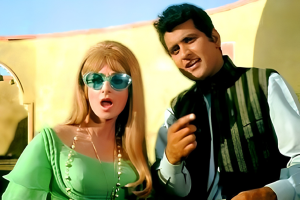
A young Indian woman stands in London, blonde-streaked hair, cigarette in hand, barely able to recall a word of Hindi. By the film’s end, she has poured her liquor down the drain, draped herself in a saree, and rediscovered her roots. That is the arc of Preeti in Manoj Kumar’s Purab Aur Paschim (1970) and it tells you nearly everything you need to know about how India once regarded its diaspora.
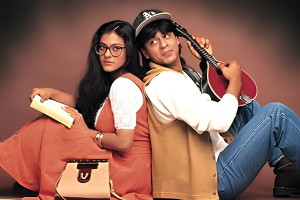
Fast-forward 25 years. In Aditya Chopra’s Dilwale Dulhania Le Jayenge (1995), a swaggering NRI named Raj romps across Europe, flirts his way through Switzerland, and winds up in a Punjab mustard field. He is charming, cosmopolitan, and impeccably desi at heart. No redemption arc required for he was never lost to begin with.
The distance between these two characters is cinematic, but it is also the story of how India reimagined itself, its relationship with the wider world, and the Indians who chose to live in it. At the heart of that story is a surprisingly simple idea: the NRI, for decades, was not a person on screen so much as a form of proof. Proof that India could travel. Proof that its identity could survive the world. What that proof needed to look like has changed enormously and tracing those changes tells you more about India than about any NRI who ever actually lived abroad.
The Cautionary NRI: Post-Independence to the 1980s
In the decades following Independence, the NRI on screen was less a figure of aspiration than one of warning. Films like Purab Aur Paschim presented life abroad as a moral test, one that many Indians were failing. Preeti, raised in London by a father who has grown contemptuous of his homeland, doesn’t merely lack Indian values. She has actively traded them for Western ones. The film’s resolution with her full embrace of Indian tradition functions as cultural restoration. The foreign land had corrupted her and only India could make her whole again.
This was not a mere coincidence of storytelling. This reflected the anxieties of a newly independent nation still defining itself in relation to a colonial past and the cultural influence of the West. India’s socialist-leaning economy in those decades was built on self-reliance and insularity. It was swadeshi (which literally translates to ‘of one’s own country’) in both commerce and culture. In that context, the Indian who left for the West was not admirable. They were, at best, a cautionary tale. At worst, they were deserters. Academic analyses of the film have noted that earlier Bollywood treated the diaspora through what one researcher called “the disparaging gaze of a ‘deserter’.” The NRI’s potential for cultural contamination had to be contained, reversed, or punished.
The Liberalization Fantasy: 1991 and Everything After
Everything changed in 1991, when India dismantled its protectionist economic model and opened its doors to foreign capital, global brands, and a new vocabulary of aspiration. Suddenly, the world felt proximate. International mobility became something to chase, not fear.
Bollywood moved quickly. Netflix’s The Romantics (2023), which features the first on-camera interview with filmmaker Aditya Chopra, offers a telling piece of context here. The son of legendary director Yash Chopra and the creative force behind DDLJ, Chopra helped redefine how Bollywood imagined the diaspora. Director Smriti Mundhra, herself an NRI who grew up in the US, describes Dilwale Dulhania Le Jayenge (DDLJ) as “a direct reflection of the diaspora and the world we live in”, noting that for her generation of Indians abroad, it was the first Hindi film that truly spoke to them. That reception was deliberate. DDLJ arrived at the precise moment when a growing diaspora audience was hungry to see itself on screen, not as a cautionary figure in need of cultural rescue, but as someone who could belong to both worlds at once. The shift was a creative decision grounded in a changed audience and a changed country.
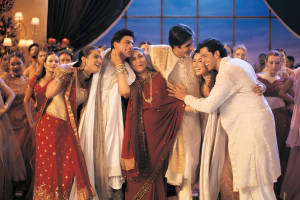
By the mid-1990s, the NRI had been entirely recast. Alongside DDLJ, films like Pardes (1997) and Kabhi Khushi Kabhie Gham (2001) introduced a new archetype, one of someone who is wealthy, globally mobile, Western in style, but irreducibly Indian in values. These characters lived in sprawling London homes and traveled freely across continents, but they wept at the sound of a Punjabi folk song and placed tradition above personal desire.
Crucially, scholars have observed that the two films approached this balancing act differently. Where DDLJ proposed that Indian identity was a ‘portable asset’ that could survive migration intact, Pardes suggested that cultural loss was ultimately unavoidable, only postponed. The anxiety of the earlier era had not fully disappeared. It had simply been made romantic.
What DDLJ did, though, was shift the moral center. Raj is not rewarded for rebelling against tradition. In fact, he is rewarded for respecting it. His entire mission is to win not just Simran, but her father’s blessing. The emotional climax of the film is not a flight into modernity, it is a quest for family approval. While the geography had changed, the value system had not. The message, received by millions across India and in the diaspora, was reassuring. It said that you could leave home without losing it.
What the NRI Represented to India
To understand why this fantasy landed so powerfully, you have to understand what the NRI meant to the Indian watching from home.
The NRI of 1990s Bollywood was aspirational on multiple levels. At the most obvious, it represented wealth and mobility at a time when international travel was still rare and ‘foreign-returned’ still carried a certain halo. But success in London or New York carried symbolic weight beyond economics alone. These were cities that occupied a privileged place in the Indian imagination after centuries of colonial entanglement. To succeed there was to answer something. But to thrive there, on your own terms, while remaining recognizably Indian, that was the deeper fantasy. The NRIs in these films weren’t aspirational because they were just wealthy. They were aspirational because they felt like vindication.
This is why, as one analysis of DDLJ put it, the NRI was transformed from “the marginal outsider” into “not just a possible Indian national subject, but possibly one of its best.” In a decade when India was renegotiating its place in the world, the glamorous, rooted NRI offered a comforting narrative of national confidence.
What these films didn’t show was equally telling. The Bollywood NRI of the 1990s never dealt with visa rejections or immigration queues. They were never subjected to racial microaggressions, or if racism appeared at all, it was cartoonishly overt, easier to dismiss than the ambient, grinding kind that real diaspora Indians described experiencing. There were no student loans, no identity crises, and no painful silences at the dinner table where one generation spoke a language the other had half-forgotten. As one British-Indian viewer told us, real prejudice “is a lot more subtle and usually communicated through microaggressions.” “It’s nothing like the cinematic version. It’s somehow worse,” they added.
The screen NRI was not a portrait. It was a projection. And projections, by design, leave the difficult parts out.
The Quiet Shift: 2010s and Beyond
By the 2010s, the old anxieties had begun to soften. Global mobility was no longer a novelty for India’s growing middle class. International education, travel, and careers had become familiar realities rather than remote fantasies. India’s cultural confidence, its sense of itself as a significant global presence, had also grown considerably. So, aspiration no longer pointed exclusively outward.
The films registered this shift subtly but unmistakably. English Vinglish (2012) uses America not as an ideological destination but as a backdrop for one woman’s journey toward self-worth. The question of whether an Indian woman can survive contact with the West doesn’t arise. It’s taken for granted. What the film asks instead is quieter and more personal. It asks if she can survive her own family’s indifference to who she is.
Zoya Akhtar’s films push this further. In Zindagi Na Milegi Dobara (2011) and Dil Dhadakne Do (2015), characters move through global spaces with the ease of people who have always belonged there. International mobility is neither extraordinary nor threatened. The old binary, India versus the West, tradition versus modernity, all of it seems to have largely dissolved. What remains is a more layered, less anxious understanding of identity. One that is fluid, geographically unmoored, and unburdened by the need to prove anything to anyone.
More recently, films like Kapoor & Sons (2016) have quietly abandoned the fantasy altogether, presenting diaspora characters whose struggles are psychological and familial rather than cultural. The NRI is no longer a symbol. They are, finally, just a person.
Every Era Gets the NRI It Needs
The trajectory of Bollywood’s NRI, from a cautionary figure to a glamorous proof of Indian possibility to ordinary human beings, tracks something larger than cinema. It tracks how a country’s self-image changes as its circumstances do.
A socialist India, slightly weary of the West and intent on self-definition, needed the NRI to be a warning. A liberalizing India, newly hungry for the world and anxious about what it might cost, needed the NRI to be a reassurance. A more confident India, less obsessed with proving herself, no longer needs the NRI to be a symbol. It can simply be a person.
The Bollywood NRI was never really a portrait of the diaspora. It was a way for India to imagine herself and negotiate the questions that globalization was raising, all through the language of romance and spectacle. What do we keep? What do we trade? Who are we when the world comes closer? Those questions mattered enormously to a generation navigating an opening India without a roadmap, and the NRI, glamorous and rooted and improbably uncomplicated, offered one kind of answer.
As India changed, so did the fantasy. And perhaps that is why the NRI feels less central today. Not because the films failed, but because the questions that once made the character so powerful no longer carry the same urgency. The work is largely done. The mirror has been put down.




Leave a Reply