

Whether it’s picking up ramen after a long day at work, shopping for last-minute toiletries before your flight, browsing drinks for a night out, or grabbing ibuprofen and electrolytes for the morning after, the corner shop is an integral cog in the British economic machine. Identifiable by its trademark layout and trusty essentials, the corner shop is arguably one of the only places that will see you in every state of being, apart from perhaps your bedroom. If you’ve ever lived in the UK, chances are, there’s a corner shop right down the lane that you swear by. But it’s not just the products that make such a store; it is the people.
In the Victorian era, their function was to provide provisions and daily necessities for the people residing in slowly expanding industrial settlements in and around the UK. Long working hours in factories and mines exposed a necessity for quick, cheap, and easily sourced food. The shops sold dry goods, such as flour, pulses, tea, salt, sugar, bread, and bacon, and were essential for feeding a growing middle class in small homes with no space for pantry staples. Transactions were noted in ledgers and settled between owner and customer on pay day. The corner shop kept adapting to the changing times — functioning as a newsagent between the First and Second World Wars, a hub for confections and toffees after the war. In this way, the corner shop became both a neighborhood staple and marvel.
The 1950s and 1960s saw an influx of South Asian immigrants settling in the UK. They entered a market with labor shortages and limited opportunity without capital, and so retail became one of the few industries that appreciated the family-run setup, one that allowed the shops to stay open for longer hours than other establishments. Dr Kiran Sahota is the founder of Believe In Me, an organization aimed at educating youngsters about South Asian history. He says: “These shop owners were used to long hours, but more importantly, [opening a shop] allowed freedom and job security. They took pride in owning a shop because it gave them social status in the community. And it created a mini community point for other newly arrived immigrants.”
Soon, the British corner shop became synonymous with South Asia, and it continues to be so, providing shelter and occupation to refugees from Sri Lanka and Afghanistan. These stores are defined by the Bossmen (and women) who run them. A term of endearment for immigrant corner shop owners, Bossmen are gaining popularity on social media, especially amongst younger generations of consumers. As one TikTok caption says: “While Starbucks is closing at 8pm, bossman’s still there giving you a Lucozade and vibes. These corner shop legends keep the community running – no reservations, no £7 coffees, just pure hustle.”
India’s pop culture introduction to the corner shop may have been from the 1995 film Dilwale Dulhania Le Jayenge, where actor Amrish Puri played the character of Chaudhry Baldev Singh, a surly owner of a corner shop in London. However, India has a very similar retail experience: the kirana store. A shop often smaller than the size of a typical room, a kirana store is a neighborhood shopping staple, hosting a variety of goods from pantry goods to the latest edition of your favorite comic book. The kirana store dominates grocery retail in India, with close to 12 million documented stores as of 2020.
Kirana stores thrive because of the demographic they serve. Often selling at subsidized prices compared to supermarkets, these stores are lifelines for low-income families. Operating on low costs and stocking up stores within a 24-hour rotation, these businesses funnel goods from local farmers and warehouses. Both the corner shop and the kirana store hold similar footholds in their respective societies; from business to community building, they’ve got it all.
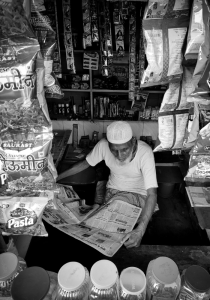
Shopkeepers have long met their challenges with determination, and many still do today. In the UK, these stores stand as a symbol of resilience and community spirit, especially through times of political turmoil. In 2012, roughly 50% of corner shop owners were Asian or Asian British. By 2025, that share had fallen to 33%, a decline driven partly by growing economic opportunities for immigrants, and partly by the discrimination they continue to face. Babita Sharma, BBC presenter and daughter of corner shop owners, speaks about her experiences in her book, The Corner Shop: Shopkeepers, the Sharmas and the Making of Modern Britain. “The riots that engulfed the early 1980s would provide ample opportunity to play Speaker of the House…Our family observed the mantra of “keep your door open, your mouth shut and smile sweetly at any passing trade”. It saved us any aggro in the longer term,” she says.
But shops have a way of pulling through. Their ability to respond quickly to the changing needs of the community enables their perseverance through tough times. Londis N16, situated in East London, is one such corner shop. Karsan and Mahalaxmi Patel opened the store in 1979, after immigrating to the UK from Zambia. Now, the next two generations are running the store. Priyesh Patel, their grandson, says: “They passed on to us that we should be accessible and provide something for everyone in the community. We can evolve with the community, because the community is always changing as different people move in.”
Another sign of a changing community comes with the rise of apps like Blinkit, Swiggy Instamart, and Zepto in India and Deliveroo and Uber Eats in the UK, which deliver a level of convenience the neighborhood shop can’t match. Questions of the shop’s ability to persist against this wave of superstore conglomerates and quick commerce are aplenty. A report by Grant Thornton Bharat describes a reduction in reliance on kirana stores by 51%; but not to worry. As the report notes, “This does not indicate a loss of relevance; it reflects a redistribution. Consumers still visit kiranas, but for different kinds of shopping: planned purchases, routine top-ups, and trust-driven transactions.”
Kirana stores are run on trust and goodwill; a quick phone call to the local shopkeeper would have a dozen eggs and a kilo of sugar at your doorstep, perhaps even faster than an app could. The personalized service pays — these stores are expected to retain an 86% share of the Indian grocery market split, above supermarkets and quick commerce. With rising charges and hidden fees, it’s becoming cheaper to pop over to the nearest corner shop for a carton of milk. According to a report by The Observer, Gen-Z spends on average nearly £1,000 a year in corner shops.
Despite tough times, Sharma describes her parents’ love for their store: “They don’t miss the early morning wake-up calls or long hours. What they miss most is you, their customer. Whether the corner shop can survive long term depends on the unwritten pact between shopkeeper and customer. If obeyed, it shall continue to serve a nation.” Thus, our neighborhood powerhouses continue to thrive, as does our love for them.




Leave a Reply