

When did it begin this popularity?
The chronology online appears simple enough.
In 2017, a travel account calls Laitlum a “road less travelled”, a quiet detour discovered through a local tour planner. By 2018 a Tripoto account describes it as relatively pristine but that it had “just started getting mass popularity” after a song sequence from Bollywood’s Rock On 2 was filmed there. Another 2018 account says that despite its gradually increasing popularity, few people had heard of it.
In this time, Instagram happened.
In the late 2000s, when we first went to Laitlum, it was still a relatively small, urban social network in India. Then came cheap, ubiquitous mobile data, the great expansion of smartphone internet, and, in 2020, Reels. Instagram became one of the principal ways Indians encountered the world in images and short video. Meta’s advertising data put its Indian audience at 481 million by end 2025, making India its largest national market. So it’s hardly surprising that when we jump forward to 2026 in our Laitlum story, we find numerous travel sites explicitly listing it as one of Meghalaya’s “top Instagrammable spots”. Some complete with “pro-tips” on where to click photos with the most dramatic backdrop. Like with other “Instagrammable” spots, Nong Jrong for instance, now famed for its sunrise views, it might have started with one geo-tagged video that went viral. The Laitlum Reels on Instagram, on Youtube, number in the hundreds, if not thousands. Image after image not simply recording the destination but helping to produce it.
How strange to think of it: the hills and canyons were always there. What changed was that they became a sight — something marked out, named, passed from one person to another as worth seeing.
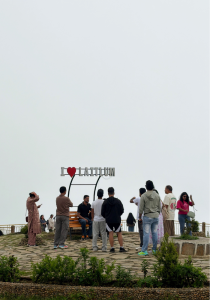
The image of Laitlum, I imagine, travels far ahead of Laitlum itself.
Meghalaya Tourism still describes it as a “secluded hilltop destination” but this is no longer true. “Two hundred cars a day,” Edison Nongspung, resident of Shnong Laitlum, tells us. “When it’s off-season.”
So, what happens to a place when it is discovered?
For Edison and his father, Bah Phillip Mylliem Ngap, Laitlum’s Rangbah Shnong, village headman, the changes have been dramatic. “Laitlum was very poor,” Bah Phillip told us. We are in his home. Outside, much activity as the shnong readies for a synod meet over the weekend at the Presbyterian church next door.
Bah Phillip is an old-timer, impeccably dressed in coat, pressed trousers, polished shoes. When he became headman in 2003, there was nothing, he says, no work, no schools. “I went from one government department to the next, pleading for funds.”
We learn from them also that Laitlum is named not so much for being where the hills are set free, but where, for someone climbing up from the villages in the canyon, it was the place where one was free of the hills.
This makes perfect sense because Rasong, the village by the Umsong River flowing through the canyon, is “tynrai”, root. Laitlum, though over a hundred years old, is the place where people from Rasong, on their way to Smit, to its large historical market, to sell bananas and broom grass, would rest and spend the night. This is how Shnong Laitlum became a shnong.
“Here, there was nothing,” Bah Phillip explains. “Too dry, too wet, too barren. Nothing but stone underneath us… ki kynjat ki maw…as though the stone from the cliffs skirting the village had kicked up into the village itself. Nothing would grow. No crops. No trees. Everything turned to wind.”
With tourism, people found hope.
“Or at least,” he adds, “that’s what everyone is now going after.”
The shnong though has little to do with the viewpoint or its earnings, since the ‘park’ land is shi met — “single-bodied”, privately owned rather than community owned — belonging to families within the larger, most prominent clan in the area, the Nongspungs.
“So, what does the village get?” I ask quickly.
Donations, say father and son.
“Even now?”
Edison, quiet, ever courteous, replies, “Let’s say that’s the case.”
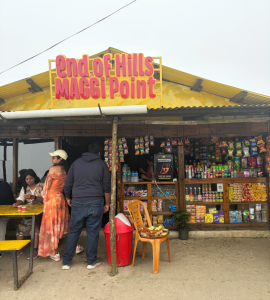
Later, Sam and I sip tea and munch on banana cake in the parking lot.
We chat with Kong Ïahunlang Mylliem, Kong Thei, from Shnong Laitlum. She has been selling tea here for almost five years. The viewpoint was managed by the shnong, she tells us, at least to begin with, then not so long ago, the Nongspung families who owned these lands chose to privatize. “Multiple Nongspung families,” she adds. We realise now why we pay separate parking and park entry fees. Why there are tall fences running along the pathways, not for safety but for demarcation.
My heart sinks at this; even though all might be amiable between the clan members, it’s impossible to ignore how divided the tableland appears.
The Laitlum phenomenon has been good to Kong Thei, though; she is able to support her family, her eldest children have found jobs as security personnel here. Even though at night they attend computer classes, she tells us. “Because it’s important.”
“What do you wish for Laitlum?” we ask.
“That more and more people come,” she responds, smiling. “And have a good time.”
I realise it’s easy, from the outside, to imagine tourism as something that happens to a place. But Kong Thei’s answer complicates that. There is money here, work, possibility, even hope. The people who live around Laitlum are not simply preserving a place for us to look at; they’re making a living from the fact that we are here.
We wander to the edge of the parking lot. It’s a Friday, and before us, a crowd of families, young couples, groups of friends. Many who are, as people here would say, “na shabar”, from outside. The cars parked behind us mostly carry Assam number plates, a few from UP, one from Gujarat, a handful with Meghalaya’s ML. We tap on the window of a local black-and-yellow taxi. Bah Meban Pyrthuh has reclined his seat and is scrolling on his phone, but he kindly steps out to have a word with us.
He’s come here today after picking up passengers from the Inter State Bus Terminal (ISBT). “Tang ar ngut,” he tells us. Just two, a young couple from UP. It’s a lucky day, for it isn’t always easy to find passengers. Tourism has its whims and fancies. Its fickleness.
Especially at the hint of any “trouble” at the state border. But also, because visitors coming to Laitlum travel up from Assam, from Guwahati mostly, where the airport and railway station are, in Assam cabs. “I’m part of the union,” he says, and they’ve made demands on the government many times to come to an arrangement — like in Sikkim — to only allow local tourist taxis to operate within the state. “We drop people off at their ISBT, and they drop passengers off at ours. It’s only fair, isn’t it?” Otherwise, he says, tourists book package deals that can cost ₹1,500 for a trip to Laitlum, while a local cab might charge ₹2,000.
While we talk, Bah Meban’s passengers return. We thank him and move away.
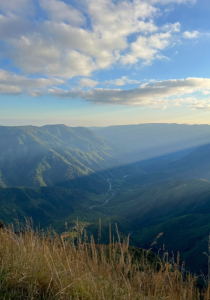
The fog has lifted but a little.
We strain to catch a glimpse of the view. Someone complains that this is not how it looks on Instagram. “For that,” I whisper, “you must come in winter.”
How easily tourists forget that places are seasonal.
People ebb and flow. The ponies stand motionless, flicking their tails, reins held by young men in cowboy hats.
Somewhere behind us begins Kaho naa pyar hain.
We follow the music. A crowd has gathered around Bah Tren Mylliem Ngap as he sings, clapping, cheering when he’s done. He’s clearly beloved. Many hands push generous tips into his red plastic collection container. He recognizes us from earlier and grins.
We grin back. “Bah Tren,” we say, “please sing us a Khasi song.”
He has been longing to, he says, but his karaoke app doesn’t include any Khasi music.
Bah Tren has been singing here about a year; he comes up from Rasong. He never imagined he’d get a chance to make a living doing this. Someone walks up with a request, and Bah Tren busies himself again.
We walk towards the entrance to Sipro Park but carry on to the edge, past a signboard that declares this a ‘SELFIE DANGER ZONE’. Sam and I pause at the top of the steep descent; 3,000 steps down to Rasong, a little less to Shnong Rangphlang Rasong, halfway down. From here, the canyon is once again a view — river, hills, long blue-green distances — something to look at, compose, photograph. I think of how easily we begin to wonder what lies beyond the frame. Perhaps that’s part of the strange business of tourism: the search for the place that feels less discovered can simply lead us to another place to ‘discover’.
As we leave, driving past the village and B&Bs, the restaurants serving Indian and Chinese, on the road back to Shillong, a car stops us.
The driver, burly, bushy-eyebrowed, rolls down his window.
“Kahan hain ye Laitloom? Jo YouTube pe dekha.”





Leave a Reply