

We didn’t know it then. Andrew, Apdor, Lal, and I. That this would be the last summer of having the place to ourselves. We’d head out of Shillong, possibly on a Tuesday afternoon — this was the late 2000s, we were at that age of being done with college, not quite settled into jobs, and had a tremendous amount of free time on our hands.
We’d go on bikes. Me riding pillion. It never seemed to take long to leave town behind, on NH 6, past Laitkor, still only sparsely built up, onwards to ancient Smit, through Thangsning, and onto a road that opened up on the right to a view of sudden steep hills whose slopes were knuckled by tumbling boulders.
All these years later, this view at least, remains the same.
From here it wasn’t far, the place where we’d stop, beside a hedge, no gate, no signpost, and slip through into what felt like a secret world.
I remember they didn’t tell me where we were going, the first time.
It remained unrevealed until we got there.
“What is this place?” I’d whispered.
Laitlum. Where the hills are set free.
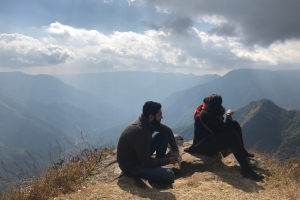
When I left Shillong for postgraduate study abroad, I didn’t realise I’d carried Laitlum with me until I found myself working on my first book. Boats on Land includes a story called Laitlum, in which a young narrator, housebound for weeks because of curfew and “trouble” on the streets, is offered brief respite and freedom, when she accompanies her older sister whose biker friends take them to — you guessed it — Laitlum.
I was writing this far away from home.
But it wasn’t at all difficult to conjure place and image with precision:
We were standing on a field at the head of a valley, flanked by rows of jagged mountains that seemed to multiply themselves, growing higher and more distant, layering each other in shades of deep blue and green. The sight stretched far and endless, as though beyond lay mountains and nothing more of the world.
I could place myself right there. Wind on my face. Dampness on my skin.
To our right, the only structure, a rickety sem lum, a hill shed.
On many days, we’d glimpse the view only through the fog. Rolling up from the valley, thick and close to the ground. We didn’t mind. We’d find our favourite spot at the edge and wait for brief clearings. Sometimes, a farmer would walk up from the villages below — they understandably never looked pleased to see us. A bunch of kids probably up to no good. And even though there was never more than a joint passed around on occasion, who could blame them?
When I returned briefly to Shillong in 2010, our little friend’s group was not quite as intact as it used to be — some had jobs or were pursuing PhDs, some had left Shillong. Andrew was still around but he said he didn’t go to Laitlum anymore.
“Why not?” I asked, startled.
He laughed. “If you go, you’ll see.”
That didn’t happen until December 2018, when friends were visiting over Christmas.
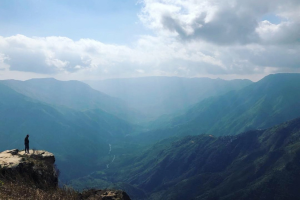
We had to pay an entry fee, which I thought was fine especially if the money went towards Shnong Laitlum, the village, for upkeep. We parked in a dusty parking lot, and wandered out over the slopes, the grass crisp and winter yellow, the canyon the color of a deep ocean. We sat at the edge, we took photographs. A man stood on the rock I think we’d sat on all those years ago.
When I returned in 2020, after a harrowing pandemic year of not being able to travel home from Delhi, my parents and I made a visit to Laitlum on Christmas Eve. The entry fee remained the same, though the parking lot had widened by miles, filled with buses, and around the edge of the slope, a huge and impossible-to-ignore fencing.
“What’s happened?” we wondered in bewilderment.
But at the time there were no answers. Only tea and cake from a Khasi kong, who carted around a kettle and a basket of snacks. Khasi kongs selling tea would become a fixture here — and it seemed like this was as far as the changes would go at Laitlum.
Except not.
When we visit this year, Laitlum is business through and through.
And it begins long before we get to the viewpoint. Along the way, numerous B&Bs and restaurants serving Indian and Chinese, even a Desi Tadka Dhaba, and a pop-up cart that promises ‘no pork’, ‘no beef’. When we arrive, the enhanced parking fee allows us entry into a paved lot that’s taken over most of the hill. There are ponies. Shops and restaurants under construction. And parks. Two parks. One beyond the parking lot, ‘Sarian Laitlum Viewpoint’, separately ticketed, paved and flower-bedded, paths encircling a giant “I ❤️LAITLUM”, and leading to a bridge and walkway at the edge of the slope. To the right, a long, fenced pathway to the other park, lined with shops selling momos, orchids, local spices. There’s an ‘End of Hills Maggi Point’; nearby, a ‘Traditional Dress’ rental shop.
My husband Sam and I are both shocked and awed.
Before we can react, we are further stunned by strains of Pehla Nasha rising into the air — coming from a baseball-hatted man on the side of the path; a group of older women, tourists, dancing before him.
We walk on to the gated counter of ‘Sipro Park: Laitlum Canyon View Point’ and discover this too is separately ticketed. We pay again. And come face to face with a large signboard carrying a list of ‘Jingmaham’ or ‘Warnings’. No drinking or gambling. No bad language. No engaging in bad deeds. No defacing property. No crossing over fences.
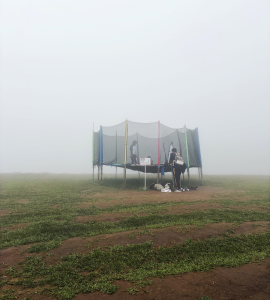
Beyond this, trampolines.
A children’s play area with swings, slides, see-saws.
A bandstand under construction, and beyond the fencing, also under construction, a concrete walkway that will take visitors along the edge of the canyon.
“Isn’t it odd,” I tell Sam, “that what people come here for is also what all this is slowly changing.” The feeling that nothing has been arranged. No gate, no signpost, nowhere to sit, nothing to do but stand at the edge and look. The more people arrive looking for that “undiscovered” feeling, the more the place is organised and orchestrated to receive them.
Is there a point, I wonder, at which a place can still accommodate us but no longer feel like the place we came to see?
Three busloads of schoolchildren from Brookside Adventist Higher Secondary School are wildly careening about the place, some have taken to the trampolines. Some are singing a Taylor Swift song. “Are you here on a school trip?” I ask a group of girls.
They giggle, nod. A geography lesson. They’re meant to ask the locals questions.
“About?”
“The environment and stuff.”
It has been raining so we walk around gingerly.
The grass is thinned out; in some places the ground is mere mud.
The day is heavy with fog.
The sky, the world, blanketed in grey.





Leave a Reply