

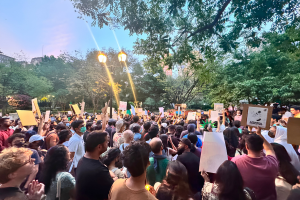
On 20th July, a group of people made their way towards Union Square in Manhattan in the evening. They were placard-carrying members of the Indian diaspora, wishing to express their solidarity with the students protesting in New Delhi against the Indian education system.
Close to their meeting spot, stands a statue of Mohandas Karamchand Gandhi that is 8 feet tall. It was installed in 1986. It makes one think — how common are Gandhi’s statues in the very visible world of global cities? Gandhi stands and sits in Johannesburg, Beijing, Hiroshima, London. Do protests that align with his political beliefs remain confined within national borders or do they have offshoots across the world? Why do Indian protests now have audiences and participants across continents?
Diasporic protests by themselves are not a new phenomenon, but it is worth asking questions about the issue that triggered the protests in July 2026. That is because it reveals the aspirations of a subset of the Indian population, in this case, the youth of the country. Many of these are students and on the verge of entering the workforce.
This is a generation that still somehow managed to find reasons for laughing, although they were peddling in the grim business called dissent. The Gen-Z population (people born in the years between 1997-2012) has been labelled as a generation of ‘unserious’ people, yet who are not afraid of tackling serious issues, the likes of which include demanding accountability from the government.
But what about their friends and family who have now moved abroad? How do they respond to events in the mainland?
The date for a peaceful walk from the Jantar Mantar to the parliament had been decided upon well in advance. People were asking for the resignation of the education minister, Dharmendra Pradhan, for his lack of oversight on the National Eligibility cum Entrance Test (NEET), which decides whether young students can qualify to study medicine, and become doctors in the future. When word spread in May 2026 that the question paper had been leaked, and the test would be conducted again, it left a tremendous impact on the lives of the aspirants. There were more than twenty aspirants who died by suicide.
To voice their support for the movement, some people decided to fly to New Delhi from other parts of the country, and some from outside the country. For those who couldn’t travel, their current place of residence became the site of protest.
In New York City, on 20th July, that venue was Union Square — a protest initiated by Hindus for Human Rights, an organization based in Washington D.C. It was possibly a deliberate decision to have Gandhi in the backdrop as members of the Indian diaspora convened to speak about the situation unfolding in India. After all, Gandhi was known for preaching the ideals of non-violence during India’s fight for independence from British colonial rule.
“The beauty of the current youth uprising in India is that it brings together those who love Gandhi, those who love Ambedkar, those who love Bhagat Singh,” says Sunita Vishwanath, the Executive Director of Hindus for Human Rights.” Rather than these historical figures forming lines of division between us, the protests have truly united us.”
Unlike the protests in New Delhi and other Indian cities, people showed up in limited numbers. But what propels these individuals to align their timing with Indian protests, and show up when there is such a massive geographical divide between Indian cities and their locations? Vishwanath suggests that the diaspora never stopped following Indian news from close quarters, and that inspiration to join protests transcends borders. The compression of distance is also carried through fervent discussions on mediums such as Instagram, Facebook and Whatsapp, through which people receive real time updates.
These are individuals who have retained their Indian citizenship, or they have Indian roots which they feel strongly towards. After all, one of the catalysts of the movement, Abhijit Dipke, was residing in the US, when he decided to come up with a satirical page named the Cockroach Janata Party (CJP).
These protests also highlight the efficacy of those who can demonstrate support for the cause in lieu of being physically present at the site. This includes online work — creating educational content on the political history of India, reminding people of their constitutional rights, and for some people in the comment section, one can also find tips and tricks to protect themselves from the harmful effects of tear gas.
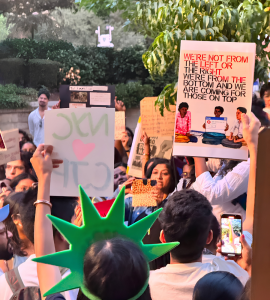
There is also a deep-seated curiosity about who is funding the protests. The answer might be people galvanizing support for the movement by sending food and supplies through quick commerce delivery apps such as BlinkIt. It’s coming from those people who are employed and have disposable income. Many millennials have also offered to arrange for flight and train tickets for those who wished to travel to the capital of India, but lacked the means to do so.
Even as we reside in different parts of the world and the country, several gaps in understanding and communication have been bridged through social media. People are no longer relying on traditional media outlets in India for news, but are watching developments unfold on their phone screens.
Turning up for protests felt necessary because people care deeply for the homeland they (or their parents) once lived in; through these moments of solidarity, one finds a way back home. With the Indian diaspora scattered across various parts of the globe, and their need to express a connection with their erstwhile homes, the Indian protest could truly be considered to be a protest of the world.




Leave a Reply