

Step outside in most cities today and you’ll feel it immediately. The kind of heat that clings to walls, radiates from pavements, and turns your own home into an oven by noon. An urban summer is no longer just inconvenient, for most citizens it is unbearable. In many places, it’s becoming a structural problem, one that modern architecture and infrastructure were never designed to handle.
As temperatures rise, cities have been looking for solutions. Air conditioning helps, but only if you can afford it, power it, and keep the grid from collapsing. So urban planners, architects and governments are being forced to ask a bigger question — what if the problem isn’t that we lack technology, but that we forgot how to build for heat in the first place?
That question has led many of them back to the roof.
In New York City, more than a million square feet of rooftops have been coated with reflective paint in recent years. The idea is simple. Lighter surfaces absorb less heat, which keeps buildings cooler and reduces the need for energy-intensive air conditioning. For residents without reliable cooling, that difference can be the line between discomfort and danger.
But what’s most striking is how old this idea is.
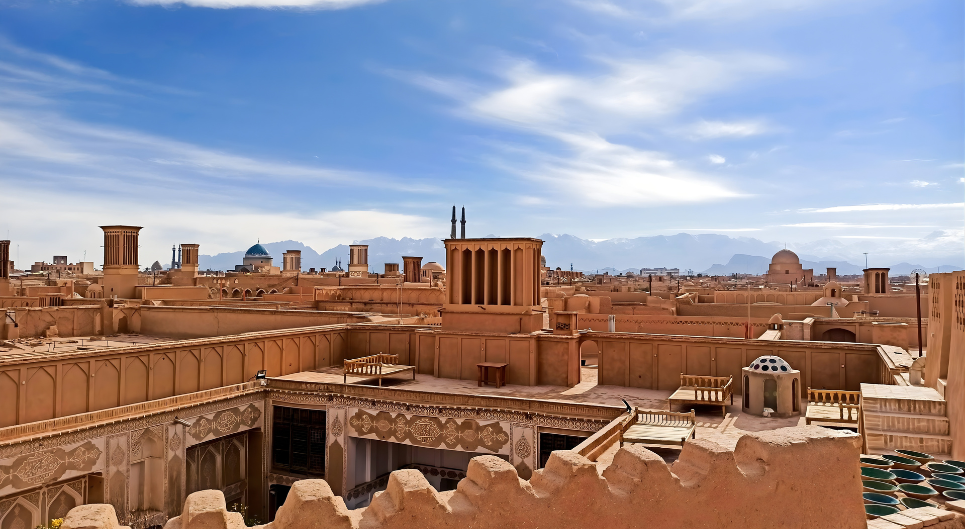
Long before ‘cool roofs’ entered climate policy documents, communities living with extreme heat had already figured out how to manage it. In parts of Rajasthan, lime-coated roofs reflected sunlight, keeping homes habitable through brutal summers. Across the Mediterranean, whitewashed buildings served the same function. These choices were practical responses to climate; only much later did we start viewing them as stylistic ones. Mud-brick construction in countries like Yemen and Mali insulates against extreme temperatures. Mashrabiya screens in Cairo filter sunlight while allowing ventilation. Stilted homes in parts of Southeast Asia lift living spaces above heat-trapping ground. None of these were designed with climate models in mind. They emerged from lived experience.
This was the kind of design knowledge that was sidelined for decades. Contemporary construction favored speed, uniform materials, glass frontage, and darker surfaces that tended to trap heat. Cooling became something external machinery was expected to solve.
Now, as those machines strain under rising temperatures, the older community logic is resurfacing.
Only recently has modern research begun to catch up. Studies now show that widespread use of reflective materials can lower ambient urban temperatures by up to two degrees Celsius, reduce cooling loads, and lessen health risks during heatwaves. What was once treated as informal knowledge is being validated in technical terms.
In Tamil Nadu, state-led cool roof programmes have moved beyond small pilots. Hundreds of government schools have been retrofitted with heat-reflective coatings, not as an experiment, but as policy. In earlier pilots in Chennai and Perumbakkam, indoor temperatures dropped by as much as 3 to 8 degrees Celsius. Classrooms became bearable again, without additional electricity demand.
In Ahmedabad, experimental cool roof projects in informal settlements have painted tin roofs with reflective coatings. The results are modest but meaningful, indoor temperatures fall, residents sleep better, and electricity use drops. No futuristic materials. No massive infrastructure overhaul.
Just paint, applied with intent.
The significance of this isn’t just technical. It marks a shift in which solutions are being valued. Instead of chasing expensive, high-tech fixes, governments are beginning to recognise that low-cost, passive interventions can make a measurable difference at scale.
These old-school climate solutions are now gaining traction in some countries. In Tokyo, the resurfacing of uchimizu, sprinkling water on streets during peak heat, reflects a similar impulse to cool cities. In Mexico City, community-led lime washing programmes reduced heat absorption in dense neighbourhoods. In parts of the American Southwest, urban design guidelines are starting to acknowledge principles long embedded in Indigenous desert architecture including shade, reflectivity, and airflow matter.
These approaches share a common trait. They work with the climate rather than against it.

There is an uncomfortable irony here. Many of these methods come from regions that were historically dismissed as ‘backward’ or ‘underdeveloped’. Their building practices were ignored in favour of globalized design norms, often from countries with colder climates, that assumed energy would always be cheap and plentiful.
As that assumption collapses, cities are being forced to reconsider.
These are not new ideas. They are responses shaped by necessity, refined over generations, and set aside too quickly. The solutions have been here all along. What’s changing is how we are looking at them.





Leave a Reply