

Diwali, the Indian festival of lights, celebrated on an Amavasya, or new moon night, is around the corner, and around the world, the celebrations have begun. Diwali holds a special significance for those who have moved away from home. This is a time for people who have moved away from home — to introspect but also to celebrate, and to forge deeper connections with friends and family. For some, Diwali is a reminder of the people, food and atmosphere of India.
The festival borrows from the great Indian epic, Ramayana. It marks the much-awaited return of its protagonist, Lord Rama, to his home, Ayodhya. This happens after he has spent fourteen years in exile and defeated the evil king, Ravana, who had abducted his wife, Sita. In South India, the festival celebrates Lord Krishna’s feat of defeating a monster. Diwali is also celebrated in the Caribbean and Sri Lanka, and in Nepal, it is celebrated as ‘Tihar’. The common thread that remains is the celebration of good over evil, and of course — illumination and colors!
And it is this spirit of a shared festival that finds expression in countless ways among Indians living overseas.
Madhurima Chakraborty, who is also a resident of New Jersey, looks back at her experiences of celebrating the festival. Working at an Indian bank, her colleagues are of Indian origin, and hence Diwali celebrations are taken very seriously at work. “They include everyone in the Puja, arrange for food — clients distribute boxes of sweets. We dress up wearing ethnic clothes and take pictures.” With her friends, she has now started a tradition of driving to Edison to buy sweets, and playing the card game, Teen Patti.
For those who have spent years away from India, recreating the atmosphere of Diwali back home is often an important part of the celebrations. Preeti Pooja, an entrepreneur and social media strategist based in London, believes that keeping cultural traditions alive is what makes a foreign country feel like home.
“Moving abroad meant leaving home, but keeping my culture and traditions alive is what makes me feel at home. Diwali comes just once a year, and it’s when I get to be fully myself and connected to my roots.”
What she misses most about Diwali in India is the people — family and friends, and the ease of visiting one another during the festive season. She also misses the noise, the busy streets, the sparkling lights and the smell of local food shops.
Now a mother, she puts in considerable effort to create a festive environment so that her son can learn about his roots and feel proud of where he comes from. For her, it is a reminder that home is where the heart is, and that culture and traditions can be kept alive if one makes the effort.
Madhurima’s experience is echoed by Malika Kamboj, a marketing specialist based in New Jersey, who also misses the effortless festivity of celebrating Diwali in India. “What I miss most about Diwali in India is how you don’t have to make an effort to feel festive. The lights, the mithai, the family gatherings, the chaos of getting the house ready, it’s all around you. In New York, life goes on like any other day, and you have to create that festive feeling yourself.”
Over the years, however, she has started bringing little pieces of India to New York. Last Diwali, her entire menu was inspired by the street food and chaat of her hometown, Varanasi.
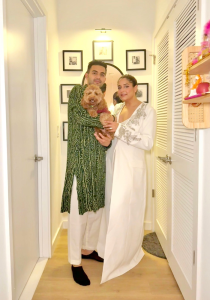
A similar sentiment resonates with Sayali Dongre, living in London, for whom this will be her third Diwali away from home. “When I think about Diwali, I don’t immediately think of the grand celebrations. I think of those mornings when the entire house would be awake before I was, the smell of faral coming from the kitchen, everyone getting ready, and someone reminding us that we were already running late. I think of sitting outside making rangoli, spending hours with my cousins building our little Diwali killa, bursting crackers, visiting relatives, and making plans with friends that would somehow change every other hour,” she says, “And it wasn’t just home. It was the entire city. The colourful akash kandils hanging outside houses, the streets glowing with lights, the crowded markets, the sound of crackers in the distance. Even stepping outside for something as small as buying groceries felt festive.”
This year, she is organizing her first Diwali Pahat celebration in London, extending the same spirit of togetherness to a larger community. She hopes that those celebrating their first Diwali away from home, particularly students and recent arrivals, will find familiar music, faral, new friendships and a sense of belonging. “I started doing all of this because I missed home. I never imagined that, in trying to find a little piece of it for myself, I’d get the chance to create that feeling for so many others,” she reflects.
Sarmistha Ghosh Moulik, who has spent 15 years away from home, talks about feeling confused about the dates on which Kali Puja and Diwali would fall, and marking the festival by lighting diyas and burning a few sparklers. At present, however, her teenage daughter is more keen on observing Halloween. “Diwali is now mostly dressing up and going to a friend’s party, while our firecrackers lie tucked away in the basement, thanks to suburban firecracker laws. And slowly the glimmer of Diwali has been reduced to that one lone diya on my doorstep,” says Ghosh Moulik.
For some, the passage of time has also brought a change in the way the festival is celebrated. Chef Nupur Arora, who arrived in New York almost thirty years ago as a new bride, remembers the early years of celebrating Diwali in a joint family.
The family clung to Sindhi rituals and YouTube aartis but “while we bahus dutifully served the Sindhi dish satt bhajiyoon (7 vegetable mélange) and prayed for prosperity, I secretly spent every Diwali night daydreaming of the classic Punjabi Sookhay Aloo, Poori and Chholay from my Bengali mom’s kitchen! This was the only menu I had associated with Diwali from the day I was born and no vegetable mélange could erase that memory!” says Arora.
This year, however, Arora is hosting a ‘Lunch and Paint’ Diwali at her restaurant, Mughlai Indian Cuisine — no bridal make-up, no heavy lehengas, just a cosy oasis of diyas, urlis, fresh flowers and samosa chaat. It is a ‘Ghar Wali Diwali’, designed for friends who have lost both parents and feel orphaned, college students who are miles away from home, and empty nesters like her who spent their youth making everyone else’s Diwali perfect but forgot all about themselves in the process.
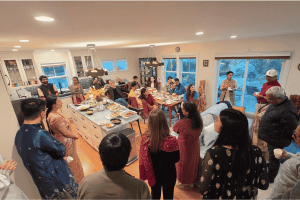
A large section of these is made up of students also seeking a piece of their home. Juggling deftly between academic pressure and assignments, they find a way to throw a dinner party at home — often older students making space for the younger ones.
A Virginia Tech PhD student, Madhuri Deb, who completed her postgraduation at Rutgers last year, says that “last year, during my time at Rutgers, I made some wonderful friends — a husband and wife. The latter was pursuing her Master’s in Computer Science. They kindly invited me and a few friends to their Diwali party. I took some homemade vegetable pakoras along with kaju barfi and besan laddu for the couple. We spent the evening talking, playing ‘Never Have I Ever’, and enjoying the incredible spread of food the other guests had brought. Rutgers also had so many vibrant student organisations — from the Hindu Yuva and Hindu Student Council to the Jain, Malayali, Bengali, Tamil, Marathi, etc. Student Associations. They represented nearly every state in India. It is New Jersey, after all, the heartland for desis!”
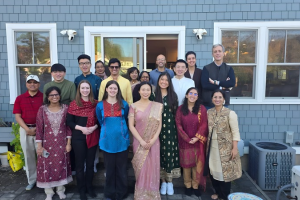
Bhramar Mukherjee, Anna M.R. Lauder Professor of Biostatistics at Yale University, reflects upon this time of the year. A few days before Diwali, she invites her colleagues and students to celebrate Lakshmi Puja at her home, and encourages them to dress up in Indian clothing. The food for the occasion comes from a restaurant in Jamaica, New York City, while she gets her home in Branford, Connecticut, ready. She feels that one’s personal religious identities do not get in the way of these gatherings, and neither does one’s race and nationality.
The fact that New York’s public schools have been observing holidays for the last three years also speaks to the political and cultural clout the community wields in the US. The states of Pennsylvania, Connecticut and California also commemorate Diwali as a public holiday after members from the Hindu community rallied behind the cause. Even the US Postal Service recently issued a stamp to celebrate Diwali.
Since 2023, Walt Disney World in Florida has been observing a new tradition — the Diwali Dance Fest. In 2026, nearly 500 people participated in the dance performance, donning elegant purple lehengas and cholis as the Disney castle structure stood tall in the background.
In a more formal capacity, federal engagement around this festival began in 2003, when the George W. Bush administration hosted the first official White House Diwali celebration in the Indian Treaty Room. Barack Obama lit a diya in 2009 within the premises, and under the Biden-Harris administration, Diwali celebrations were observed with a grand reception. In Canada, former Prime Minister Justin Trudeau was known for partaking in Diwali rituals and engaging with the Indo-Canadian community during the festivities.
The renowned filmmaker Mira Nair co-hosted another soiree at an Indian restaurant named Passerine in Gramercy Park — as she steps into a new role this year: being the mother of New York City’s mayor, Zohran Mamdani. Earlier, at a much smaller scale, she co-hosted a small dinner party with Salman Rushdie and Radhika Jones (ex-editor of Vanity Fair) for her friends and associates, held to support the Asian American Writers’ Workshop. At previous functions, guests lit candles and made rangolis at her home in the Upper West Side.
After all, home isn’t just a place on a map; it is a living, breathing feeling that we carry with us. As Kamboj says, “I think that’s the beautiful thing about living away from home, you don’t leave your culture behind; you find new ways to keep it alive.”




Leave a Reply