

We’ve done it, you’ve done it – we’ve all scrolled past an Instagram reel in T-minus 3 seconds. Either the thumbnail isn’t attractive, the content looks uninteresting, or you’ve seen one too many reels like the one on your screen before – but the seemingly automated thumb movement pushing one video into the next is an adaptation even Charles Darwin couldn’t have anticipated.
While this is a very real, very apparent problem for consumers, it poses an even greater challenge for creators, who now have to squeeze their content into a hook that not only captivates the audience for those three seconds, but keeps them coming back for more.
The attention span problem is not a new one, and certainly not bound to the world of media. Centuries ago, when there were no phones, internet, or even electricity, scholars and monks pondered over the question of distraction. Books were once seen as the agents of destruction – the very habit people are struggling to get back to was once the root cause of dismay and alleged impropriety. From the 12th century Chinese philosopher Zhu Xi’s proclamation: “The reason people today read sloppily is that there are a great many printed texts,” to a Time news article from 2008 warning about the dangers of ‘newstritional disorder’, our attention has always been perceived of being in danger of slipping out of our hands.
The difference between the philosophers and modern-day skeptics lies in the fact that attention is no longer something personal that can be engaged and disengaged at will. Attention is a commodity, for which there is both an industry and a consumer base. The contemporary understanding of the relationship between the two originates in a 1969 lecture by Herbert A. Simon. He argued that in an emerging attention economy, the cognitive capacity to process information was itself a productive resource. This means that an individual’s capacity to take in information, that is, their attention, is subject to the same logic of scarcity and allocation as any other. By diverting attention to one video above another, we are treating that video as a resource; and the creator on the other end of the transaction receives monetary compensation for that attention.
And so, creators must innovate. With the attention span having declined from about two and a half minutes in 2004 to an average of 47 seconds currently, they must come up with new ways to break through the video noise and grab the fancy of whichever randomized consumer’s For You Page the video happens to land on. One such innovation is the Instagram Series. Even before it became a formal feature in June 2026, creators were cutting down Get Ready With Mes (GRWMs) and story times into multiple parts, recreating an episodic strategy to compel watchers to stay on their feed. If a creator manages to tell one half of a gripping story in a 30-second video, chances are, people will click on their profile to search for the next part. The new feature makes this search even simpler by allowing creators to organize their content into different series of clips, which users can binge by using the Watch Next option.
The interest still lies in the completion of a story; the problem arises when one only gets a few seconds to do so. Herein comes the hook, which works as the USP of every video. Often misleading and laden with clickbait, the hook enraptures the audience in a way that forces them to watch more. This method mirrors the 1-2-3 filing system popularized by the Associated Press close to 20 years ago, when faced with the problem of oversaturation of news consumption. This method suggested starting with an alerting headline, followed by a short explanation, and then added details regarding the event.
By making content into a series, the creator has the explanation portion taken care of. Audiences are already invested in the story. Social media strategist and entrepreneur @juliabroome, whose Instagram currently has 390,000 followers, talks about this feature: “The algorithm wants you to have a signature series…the goal is to give your audience a recognizable premise, a consistent format, and a reason to come back for more.” Making a consistent comparison to television, Broome explains how the feature can be used to reach more potential followers.
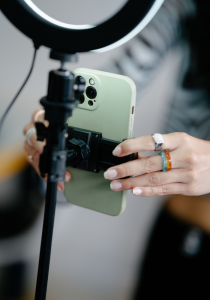
Christina Kirkman, social media influencer, has filed her very popular boxing videos under such a series. Brooklyn Coffee Shop, a satirical mini-video series created by Pooja Tripathi, is an Instagram page of its own, with over 677,000 followers as of this article. Sophie Silva, known for her ‘31 days of Halloween Costumes’ series on Instagram and TikTok, amasses millions of views on each video of her dressed up in shockingly elaborate and detailed outfits, from Black Swan to the Fairy Godmother from Shrek 2 and more.
This format is also used in the now booming vertical movie industry. These ‘verticals’ are essentially episodic movies which last around 1 to 3 minutes, stretched across multiple small bits. Seen across countries, verticals now have their own apps dedicated to the 9:16 aspect ratio: ReelShort, DramaBox, and Goodshort in the US, and KadhaiShorts and Jio Hotstar’s Tadka in India. Revenues for the industry are expected to exceed $16.2 billion by 2030 in China, and about $3.8 billion by 2030 in the US, according to Deadline.
The issue with this premise is fundamental. The simulation of continuity while the content remains the same as it would in one long-form video promises both effort and new information while seldom providing so. Short-form video continues to proliferate, rewarding creators for posting more by boosting their videos onto the algorithms of more consumers, while the audiences continue to engage with content with little to no critical thinking. The ramifications are worrying – there is very little research done on the effects of short-form video on the brain. Yes, the words ‘dopamine’ and ‘serotonin’ are thrown around once in a while, but the way the videos actually affect the human mind in the long-term is scarily unknown. Dr. Gloria Mark, a psychologist at the University of California Irvine, talks about the relation between rapid attention switching and an increase in perceived stress. University of Bristol researchers correlate the constant change of context with degradation of prospective memory – the ability to recall something you had intended to do.
Short-form video series now exist on YouTube, TikTok, Instagram, Facebook, Snapchat, and even LinkedIn. The new Instagram feature is just one of many designed to retain maximum users on the app. However, it also adds to an existing roster of harmful repercussions, and this mustn’t be taken lightly. That which is easily digestible is made so at the cost of critical analysis. As long as information is spliced and spoon-fed, any new feature will thrive. While creators learn to grapple with a new turn in an already overwhelming industry, consumers must at least attempt to be cognizant of the stratagem.




Leave a Reply