

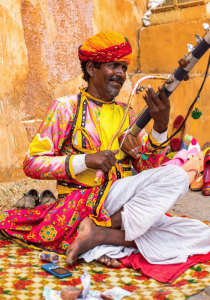
A blanket of marigolds, pleated into a garland by a vendor in a sari, her face cropped out so that only an arm and crossed leg remain. A procession of rural, traditionally dressed women, sashaying down an ancient stepwell. An old man with rumpled clothes and an ektara. A camel and its keeper posing in front of the Taj Mahal. A rural woman stepping into a blue-painted haveli.
Now consider another set of images.
A circlet of mountains crusted with icicles, a sleek red train cutting through the snow. Cottages across green, sun-dappled hills. A charming café on a city street. An ancient church girdled by autumn foliage. An elaborate Continental breakfast overlooking ancient ruins. A windmill gazing out at a field striped with tulips. A line of backpackers summiting a peak, dressed in the latest mountaineering gear.
Every one of these guidebook cover images is gorgeous. They are, in every sense of the word, cover-worthy. But they also instantly tell us something about the place, before we even turn the first page.
The first set of pictures are from India. The second set? Europe.
We’ve been trained to recognize one as ‘exotic’ beauty. The other one is simply beautiful.
And therein lies the heart of the problem. Not that the images are false (they are not), but that they are incomplete. A country almost the size of a subcontinent is being continually pancaked into a stereotype of itself – traditional, economically fragile, spiritual, chaotic, and ‘exotic’, its people meant to be put on a cover and ‘consumed’. And when this representation feels more authentic than a larger, more complex reality, that’s when the problems begin.
Ali Behdad, a prominent cultural theorist, addresses this in book Belated Travelers: Orientalism in the Age of Colonial Tourism, writing that “the Orient is again represented as a “natural” theater where the tourist can observe exotically untouched scenery, the local habits and costumes, and the exhilarating show of color…”
And India is all of those things: to deny the color, spirituality, poverty and chaos would be to deny that the sun shines in summer. But it is also far more than the spice-heaped market, the elephant thumping through the streets, the dilapidated Rajasthani havelis, the shy street vendor with the intense gaze, her sari pulled to cover her face. It is equally the music festival in the mountains of Arunachal Pradesh, the imagination-defying root bridges of Meghalaya, the vineyards of Nashik, the charming café on a busy street corner in Pune.
When these become the recurring vocabulary through which an entire country is explained, both visually and textually, they stop being observations and become clichés, shorthand for a way to explain a complicated, variegated people with an ancient history.
This shorthand has a long history that unspools back to colonial-era guidebooks such as John Murray that invited European travelers to ‘construct’ the places they described, presenting India as ruins, legends, spirituality, poverty and spectacle, thus helping to reinscribe Western ideas of cultural and economic superiority.
“The Orient was almost a European invention,” wrote Edward Said in his seminal work Orientalism, and argued that Western culture “gained in strength and identity by setting itself off against the Orient.” The West was uncomplicated, rational, forward-thinking, while the East was poor, mysterious and regressive. Thus, the traveler arrives with expectations already set in stone, assured in their superiority.
Travel media has always been the conduit through which countless people learn about other countries and cultures. It shapes their understanding of places and people, and how they should act and behave with others. And so we must wonder what happened when for centuries, the voice of the Western male white traveler was dominant, his gaze seen as the only worthy one.




Leave a Reply