

As mist rolls off the peaks of Shillong, a schoolboy tosses and turns in his bed. The moonlight peeks through the wood-paned windows, illuminating the glossy poster of Bhaichung Bhutia plastered on his wall. The droplets of rain rap on his window, a pleasant pitter-patter through the night. The tranquil milieu suddenly breaks as he wakes up, startled. The digital clock next to him reads 12:13 AM. He sighs with relief; just in time, he gets ready to witness what he and the rest of his school friends have been waiting for. It’s time for the FIFA World Cup 2026, and the Government of Meghalaya has announced a state-wide holiday for the special event.
Not just Meghalaya, but the entirety of North-East India buzzes with energy as football season comes around. Home to some of the most prolific players the country has ever seen, the eight states – Manipur, Mizoram, Sikkim, Nagaland, Assam, Arunachal Pradesh, Tripura, and Meghalaya – are the heartland of the sport in India. Tiny shops in Aizawl sell jerseys and football gear while pubs promise to stay open late into the night – even till 4 AM – for the screening of the World Cup Final. But what fuels this relationship?
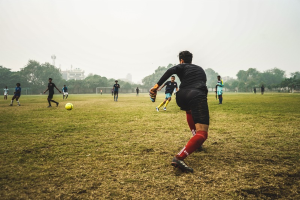
The answer lies in the history of football in the region. Once the British took control over Assam and parts of current-day Mizoram in the 1830s, missionaries moved in, bringing along with them two kinds of divinity – Christianity and football. Thus began the illustrious chronicles of football in the region. Mizo soldiers were reintroduced to football while stationed in the outskirts of Paris during the First World War and this carried on into independent India, when Dr. Talimeren Ao of Nagaland became the first captain of independent India’s football team. Then came Bhaichung Bhutia, nicknamed the Sikkimese Sniper, who changed the face of Indian football and the North-East along with it. Bestowed with the Arjuna Award and a Padma Shri, he is lauded as the pioneer of football in India.
Football persisted in the region through tumultuous terrain, a brutal partition, and the carving of new borders through princely states and united territories. In a country where the hotter states of Madhya Pradesh and Haryana are known for wrestling and land sports and the cold-weather sports are restricted to the northernmost states, the North-Eastern states surpass geographical barriers and natural disasters to build artificial turf to stay connected to the game they love most. Renedy Singh, former midfielder and Indian professional football coach from Manipur, talks about the salvation in sport: “Football takes away the tension. Not getting tickets, not getting to school every day, dealing with a bandh every alternate day. Football is the only way Manipuris think they can be in peace.”
According to the 2011 census, the region holds a population of close to 46 million individuals, making up 3.78% of the total population of India. And from within this 3.78%, Mizoram and Manipur alone make up 25% of India’s premier professional male football players, as of 2021. Thus, football’s presence is undeniable. Home to competitions like the Santosh Trophy, the Rajmata Jijabai Trophy, the Bordoloi Trophy, and many others, the region keeps the sport alive and breathing. Dedicated sports academies such as the Tashi Namgyal Academy in Sikkim, the Sports Authority of India (SAI), and the Tata Football Academy further concretize this enthusiasm.
This isn’t just a call from inside the house. Throughout the nation and the world, football has become synonymous with the North-East, and conglomerates are noticing. Reebok has returned to competitive football sponsorship in the country with NorthEast United FC, currently 4th in the Indian Super League (ISL). And yet, India keeps falling off the board of global championships. As hopes of qualifying for the World Cup are dashed, public frustration is turning toward the government for failing to adequately support and promote sport in the country.
In September 2023, the All India Football Federation (AIFF) called for the men’s and women’s football teams to participate in the Hangzhou Asian Games, but they were excluded for failure to meet the Sports Ministry’s criteria of being ranked among the top 8 teams in Asia. However, with the addition of senior players and the stellar winning performance of the national team in the Intercontinental Cup and the South Asian Football Federation (SAFF) cup, the Ministry relaxed its rules and the teams were able to participate. Regrettably, similar accommodations could not be made for the 2026 Asian Games, despite both the men’s and women’s teams qualifying for the continental showpiece; once again due to the Ministry’s criteria.

In spite of these lapses, the states of Meghalaya, Manipur, and Mizoram still shine as crown jewels of football in India (with the support of the other five states). In a part of the country where, as football journalist/commentator Novy Kapadia says, “neither Bollywood nor cricket has reached”, football shines. It is up to institutions to match the talent.
The North-East of India functions under a sort of mononym, with its geography becoming its unquestioned defining feature. The flattening of 262,179 square kilometres of land into a singular face erases the internal identities of the people. But amidst this, football becomes a united collective identity for the people themselves. Larsing Ming Sawyan, the owner of Shillong Lajong FC (the region’s first professional football club from Meghalaya) believes that football can reframe the reductionary perspective. His belief is that his football club was the “first real pan-North-Eastern initiative…that has looked at uniting the entire region”.
Yet, as with any identity shared amongst several people, differing ideologies emerge. Robert Romawia Royte, owner of the Aizawl Football Club, understands the role football has played in bringing the region to the forefront of Indian sports. However, he differs from Larsing in matters of identity: “The feeling for Mizo identity, for Manipuri identity, Khasi identity, Naga identity is much stronger than the feeling for a common North-East…in the context, let us say, of football.” In a way, it is these disparate points of view that make the North-East such a force of nature. Contexts are ever evolving, and yet they play football as they always have been. It is for the rest of us to understand whether that defines them, or defines India for depending on one region to carry the emblem of a global sport.




Leave a Reply