

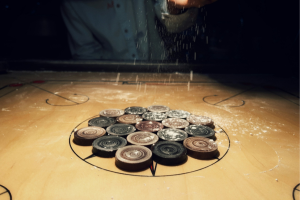
For most South Asians, the carrom board was a fixture at their grandparents’ homes, played during sun-scorched summer vacations when it was too hot to play outside. Guest houses and hotels from an older era had one, and a pair of bent heads over a wooden board was once a common sight. But things would change; younger generations began bending their heads over iPads and Instagram, and carrom boards grew dustier and dustier.
Now, though, thanks to a band of enthusiastic carrom-heads, the game is gaining a fresh lease on life, halfway around the world from where it began. For it did most likely begin in South Asia.
It’s origins are somewhat murky but signs seems to point to the fact that the game has been played in the subcontinent from at least 18th C (some sccounts date the game at least a century later). A glass-topped carrom board still survives in a Patiala palace, adding fuel to the story that it was a game once beloved by Indian royalty.

Whatever its origins, one thing is clear; carrom became a game deeply beloved by South Asians. What might once have been the purview of clubs and rest houses moved squarely into the home, and by the 1930s, people were flicking away to glory in tournaments in Delhi, Madras, Calcutta and Allahabad. The All India Carrom Federation, founded in 1956, standardized equipment and rules and helped turn a family pastime into a sport. Before the Federation stepped in, we are told by the Federation website that “Players were taking their own time to make every stroke like chess. There was no ban on smoking and hence more time. The games were extended for the whole day and became boring for the spectators.”
Naturally, such a beloved game was carried to the UK by the British as well as by diaspora communities, trying to take a tiny slice of home with them.
Much of the momentum around the game today comes via Karrom, a UK-based community founded by Abdus Khan. Karrom pairs with prominent locales such as Dishoom to host regular carrom nights, and they are growing in popularity. At an event in Notting Hill, for example, 800 people applied for 44 places. There is even a Karrom Super League, the first in the world according to the organisers. One night of the Super League at Wembley drew 600 players and spectators, and the League has since set its sights on cities as far afield as Karachi, Riyadh and San Francisco.
The pull of the board appears to have all the obvious reasons. Time spent focused away from screens, in communion with likeminded people of every age, without the pressures of an ordinary night out. Alcoholic lubrication is unnecessary, it is a fairly inexpensive game, and it is age agnostic. Anyone from a creaky-kneed nonagenarian to an enthusiastic teenager can play with equal skill.
The younger audience is not only gathering around the carrom board. It is also moving it onto the digital arena. Miniclip’s Carrom Pool turns the game into a multiplayer mobile experience and has surpassed 500m downloads on Google Play, with nearly eight million reviews. In India it remains among the leading free online sports games.
Perhaps the uncles and aunties playing the game in Panchgani and Bhubaneswar might be taken aback by these twists in a classic game. But the pleasure they handed down is the same one now spreading to a new generation: lining up the shot, flicking, waiting and seeing where the piece lands.





Leave a Reply