

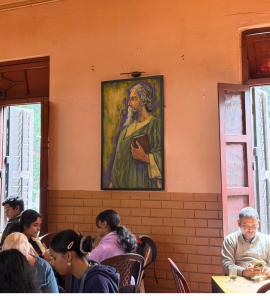
Paintings of Rabindranath Tagore, Jibanananda Das, and Kazi Nazrul Islam hang on the side of the hall. The blades of gigantic fans move the soupy air around the room. The waiters, all dressed in white with elaborate hats on their heads, move around jotting down orders from customers. Cigarette smoke lingers in the air. Groups of chattering college students walk in, and so do elderly regulars who come to reconnect with old friends and talk politics. Animated discussions fill up the two levels of the Indian Coffee House, a place where the adda still thrives.
Adda culture likely took root in the city well before the 20th century, gaining greater strength in the century that followed. In Kolkata, the term does not refer to conversation alone — it is a cultural institution, a philosophical exercise, an unhurried meeting of minds wherein politics, poetry, cinema, and revolution are dissected and surveyed over endless cups of coffee, or tea. Mind you, the coffee itself is terrible.
But how did this unique ritual of collective rambling take root in the city’s soil, and what forces have nurtured, sustained, and threatened it through the shifting tides of time? To understand adda, one must trace the historical currents that forged modern Kolkata’s intellectual awakening. Bengal’s early embrace of modernization and Western education opened intellectual floodgates unlike anywhere else in British India. Propelled by early access to modern schooling and tutelage, a nascent Bengali intelligentsia began to engage critically with colonial modernity. A monumental milestone in this trajectory was achieved when Satyendranath Tagore, the elder brother of Rabindranath Tagore, passed the rigorous Indian Civil Service (ICS) examinations in 1863, becoming the first Indian to enter the hallowed ranks of the ICS. This achievement shattered the glass ceiling of imperial administration, signaling that the colonized subject could match, or even master, the intellectual rigor of the empire.
This early hunger for knowledge gave rise to epochal institutions. The establishment of the Hindu College in 1817, which later evolved into the legendary Presidency College, provided fertile ground for free-thinking, radical ideologies, and literary brilliance. Young minds were nurtured under the fiery influence of tutors like Henry Louis Vivian Derozio, as they learned how to question dogma, tradition, and authority. Soon, the whole College Street area transformed into a sprawling educational and intellectual zone.
Flanking the iconic boulevard alongside Presidency were other premier institutions like the Sanskrit College (established in 1824), the University of Calcutta, Hindu School, and Hare School, along with a labyrinth of second-hand bookstores that earned the area its informal name, Boi Para — the neighborhood of books. As students, poets, and revolutionaries spilled out of classrooms and lecture halls, they needed a theater to test their ideas. Enter the culture of the coffee house. While initial iterations of adda found homes in private drawing rooms (baithakkhanas) and roadside tea stalls, the Indian Coffee House on College Street is considered the epicenter — or at least popular memory suggests as much. Here, hierarchies dissolve, as people from different walks of life and varied socio-economic backgrounds gather to chat.
This spirit of animated discourse is not confined to coffee houses alone. In Amitav Ghosh’s popular novel The Shadow Lines, the enigmatic character Tridib is constantly seen at tea stalls and street corners, effortlessly regaling an eager audience with his far-flung, cosmopolitan tales that bridge continents and histories. Tridib’s wandering, mesmerizing conversations are the literary embodiment of adda in its purest form — unstructured, deeply imaginative, and transcending immediate spatial constraints. Indeed, adda unfolds across myriad geographic and architectural sites across the city. It thrives on the concrete roak (the elevated front porches of traditional Bengali houses), along dusty roadside benches, and on the breezy lakesides of South Kolkata as dusk settles over the city.
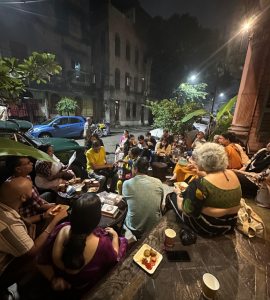
Yet, is this phenomenon uniquely Bengali, or merely a localized manifestation of a universal human impulse? Satyajit Ray, through his cinematic explorations, interrogated this claim to regional exceptionalism. Through his last film, The Stranger (Agantuk), Ray might have subtly argued—or through Utpal Dutt’s character’s cosmopolitan lens suggested—that Bengalis are not entirely unique in their penchant for endless intellectual posturing; the ancient Greeks, too, gathered in agoras (public spaces) to argue philosophy, politics, and art. Human beings have always sought out spaces to talk for the sheer joy of congregating.
Even today, Kolkata’s adda retains a stubborn, daily vitality, albeit amongst a demographic that doesn’t identify itself as Gen-Z or Gen Alpha. But they are there all right — morning walkers flock to their favorite neighborhood tea stalls after their rigorous rounds of walking around local parks or lakes are over, trading political gossip, medical woes, and cultural commentary over steaming cups of tea served in disposable clay bhaars. That these morning rituals continue regardless of the weather proves that this practice has stood the test of time. But only so far.
Contemporary realities pose perils to this cherished culture. In an increasingly fast-paced, hyper-capitalist world, adda is susceptible to discontinuity. For the uninitiated or the hyper-pragmatic individual, it can easily be misread as an unproductive indulgence in unstructured time, associated with a stereotypically laid-back, unhurried Bengali lifestyle. And as successive generations of young people leave the city in droves, migrating to distant tech hubs across the country and global capitals in search of better career opportunities, the demographic bedrock of the adda is shifting. When the opportunity arises, this culture is sometimes replicated overseas, as people from the same city seek each other out — though considerable time now goes into simply settling on a day and a venue.
Adda itself is increasingly monetized, as new forms of intellectual soirées are organized—whether through supper clubs or lectures delivered inside a bar. There, one is certain to meet like-minded people—those who have willingly chosen to pay for an intellectual pursuit. However, in these rooms, the socio-economic lines that adda once blurred become sharply defined again.
This exodus raises existential questions: Will adda survive the onslaught of digitalization, atomized lifestyles, and generational displacement? Or will it fade into a nostalgic memory, preserved only in old sepia photographs and the echoing refrains of Manna Dey’s song? He was perhaps ahead of his time.





Leave a Reply