

Ram Chandra Guha’s Environmentalism: A Global History turned out to be a sensation, in 2000. It contained important insights on the waves of environmentalism and ecological consciousness. In the years since, fiction as well non-fiction writers like Neha Sinha, Sheela Tomy, Arati Kumar-Rao, Shubhangi Swarup, and Amitav Ghosh with books like The Nutmeg’s Curse and The Great Derangement have set the scene in India for vital climate and ecological writing. Their work has resulted in a change in how environmental literature is penned — from a dry sociological critique to an urgent, evocative cultural movement.
This has paved the way for contemporary voices to alert readers about the crisis of our flora, fauna, and landscapes in ways that are deeply personal. Most of us, while thinking of the natural world, can identify the names of a few plants, birds, or talk about the free-roaming animals on our streets. However, there are tree species whose names we don’t know, there are bird species we might spy; and not just the usual crow or pigeon our eyes are accustomed to seeing.
Eleven years ago, The Guardian pointed out that nature was being purged from the Oxford Junior Dictionary. Language is responsible for moulding our perception. If a species lacks a name in our everyday vocabulary, it effectively ceases to exist in our consciousness. This linguistic erosion might also reflect a physical one. As urban development projects and housing requirements devour green corridors and industrial milestones pose a threat to ancient ecosystems, our collective vocabulary has simultaneously shrunken into a language that favors ‘indoors’. A phenomenon such as climate change is often discussed in apocalyptic, abstract terms — melting glaciers, rising levels of carbon footprints, and global temperature changes. Yet, the true grief of the ecological crisis lies in the silent disappearance of a local butterfly species, the felling of an uncelebrated avenue tree, or the drying up of a seasonal wetland behind a housing colony.
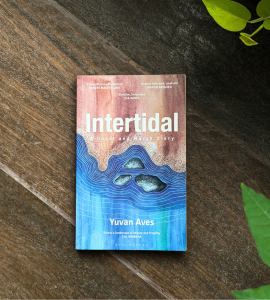
Perhaps in a bid to combat this alienation, contemporary Indian literature is undergoing a green shift. Through imaginative storytelling and intimate prose, they are rendering ecology as something palpable, emotional, and deeply personal. Two striking examples of this cultural shift are Janice Pariat’s highly thought-provoking novel Everything the Light Touches and Yuvan Aves’ contemplative non-fiction collection Intertidal: A Coast and Marsh Diary.
Janice Pariat’s Everything the Light Touches is a masterclass in how fiction can bridge the gap between scientific names and emotional ecology. The novel weaves together multiple narrative threads across centuries and geographies. It follows the journey of four people who share a love for travelling and ecology. Pariat’s brilliance lies in her refusal to treat nature as a passive backdrop. Forests, plants, and rocks are active participants — they hold their own memories, and of course there are folktales that have historically ascribed them feelings and purposes that are more complex. Through her words, readers are invited to unlearn a purely utilitarian view of the earth. By framing ecology through narrative fiction, Pariat makes complex philosophical and environmental ideas accessible to the masses. Readers do not need a degree in botany in order to wrap their heads around the consequences of deforestation. She refrains from italicizing words while writing in the Khasi language, but she provides explanations for the same nonetheless, to demonstrate how natural phenomena are communicated in the state of Meghalaya. ‘Lap mynsaw, for example, refers to ‘rain that is fraught with danger. It is sudden, strong and comes at you from nowhere.’
Yuvan Aves, on the other hand, grounds his writing firmly in the visceral, tactile present through meditative non-fiction. Located primarily in the vibrant, humid landscapes of South India, Aves’ Intertidal: A Coast and Marsh Diary is an invitation to slow down, look around, and listen. He writes about places such as the Kotturpuram Urban Forest, the Pulicat Lagoon, the Perumbakkam Marsh, the IIT Madras Campus, and the Thiruvanmiyur Beach, and the natural beings he encounters in those zones. The intertidal zone, which refers to the dynamic space where the sea meets the land, serves as a powerful metaphor for human existence in Aves’ work. It is a borderland of constant flux, teeming with alien yet wondrous life: crabs, molluscs, algae, and shorebirds that most urban commuters walk past without a second glance. Aves does not write as a detached scientist; he writes as an intimate observer, deeply humbled by the non-human entities he encounters.
His meditations challenge the human-centric bias of our daily lives. Through prose that is both poetic and grounded, Aves urges readers to develop a localized ecological literacy. He throws in Tamil phrases such as thelivu naatkal, which refers to ‘clear days’, used by fisherfolk although he is equally interested in using the scientific names of things wherever applicable. He reminds us that paying attention to a single rock pool along the Coromandel coast can unlock a universe of ecological dependencies. By shifting the scale from global catastrophe to local wonder, Aves makes environmentalism feel less like an overwhelming burden. Instead, it reads like an act of falling in love with our immediate backyard.

What unites writers like Pariat and Aves is their ability to make environmentalism palatable without diluting its urgency. For decades, ecological discourse in India was largely confined to policy papers, journalistic exposes on industrial pollution, or dense academic monographs. While vital, these formats often fail to capture the general public’s imagination.
The new wave of Indian nature writing bridges this gap by infusing ecology with a narrative intimacy, wherein the loss of biodiversity is translated into human and non-human stories that one can relate to. There’s an attempt to immerse readers in the sensations associated with the natural world: the sound of winds, or the smell of damp earth, or even invoking knowledge that is considered to be artisanal. Aves, Rao and Pariat all make use of the vernacular frequently.
After all, reversing the purging of nature from our dictionaries requires a deliberate cultural effort. We need to pay attention to folktales. Such writing demands that we look up from our screens and learn to recognize the names of the trees shading our streets, the migratory birds resting in our local parks, and the fragile ecosystems surviving on the sides of our expanding concrete jungles.





Leave a Reply