

Are you ready to rumble? At 7 feet 1 inch and 347 pounds, The Great Khali certainly was. Born Dalip Singh Rana on August 27, 1972, one of eight siblings, he became the first Indian to win the World Heavyweight Championship in 2007, muscling out 20 wrestlers in a Battle Royale. And this in a field that included Dave Bautista (the Marvel film star), as well as the massively popular wrestler, Kane.
But India’s love for wrestling wasn’t born with Khali. It had ancient Indian roots that scrolled all the way back to the sacred Hindu epics. In the Mahabharata for instance, Lord Bhima, the second brother of the Pandavas, was the strongest man in the epic, and an accomplished and beloved wrestler. Right from the fifth century, royalty would stage smackdowns for entertainment, and over the centuries the sport spun many new names, ensconcing itself comfortably into the country’s culture: dangal, pehlwani, kushti.
Wrestlers grappled with each other, not Western-style in the ring, but in the mud of the akhara. And yet, this is no ancient, forgotten sport. It has persisted into the 21st century and akhadas dot across the country, with Pune’s Chinchechi Talim, established in 1783, being India’s oldest surviving one.
One of the country’s oldest heroes was Gama Pehlwan, who rose to fame in 1895 by grappling for hours with Raheem Baksh Sultaniwala, a far taller wrestler. In fact, he was so small that he was turned away from London’s 1910 John Bull championship because of his small stature. In response, he issued a public challenge to anyone who wished to face him beyond the walls of the tournament. World champion Stanislaus Zbyszko answered and after two and a half hours of hard slog, could only manage a draw. It is said that Gama never lost a match, not once, in his fifty years of wrestling.
Following in his footsteps, KD Jadhav of Maharashtra would win bronze at the 1952 Helsinki Olympics, and Sushil Kumar ended a 56-year Olympic medal drought with bronze in Beijing in 2008, then became India’s first world champion in 2010.
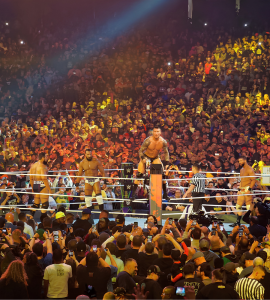
Perhaps as a natural progression, India has always been fascinated with that pro-wrestling entertainment behemoth, WWE; the country holds its largest fanbase outside the United States. (WWE has long dominated the pro-wrestling scene in America, earning revenues of up to $1.4bn.) Far before John Cena and Dwayne ‘The Rock’ Johnson found fame in Hollywood, they were enormous wrestling stars, and some of their most vocal fans came from India. And while the thrill of the regular wrestling match came from in-person attendance, somehow the experience of a WWE tournament seemed equally pulsing through the medium of a television screen. Testament to its desi popularity is the fact that it now airs in various regional languages -Hindi, Tamil and Telugu and English, and its WWE Now India is a digital weekly series that covers WWE content with a local Indian twist.
The WWE of course, is largely scripted, although its ‘actors’ continually deny it (the term ‘kayfabe’ points to how everybody, wrestlers and viewers alike, knows the action is fake but suspends their belief anyway). And perhaps this is part of its Indian appeal: the Bollywood-esque sense of drama and excitement, the larger-than-life heroes, the almost unbelievable physical antics of some rather charismatic wrestlers. That drama has often translated well to the big screen with Khali himself scoring roles in The Longest Yard, Get Smart, MacGruber, Kushti and Ramaa: The Saviour.
Enthralled by the attention Khali got, the company kept fueling this interest by hiring more desi talent, but with uneven degrees of success. There was Jinder Mahal, of Canadian-Indian origin. Then there was Dilsher Shanky from Haryana, Veer Mahan (Rinku Singh Rajput) from Uttar Pradesh, Sanga (Saurav Gurjar) from Madhya Pradesh, and Guru Raaj. Women were not left behind either, with Kavitha Devi even wrestling in a salwar kameez.
Now the sport is sprouting its own indigenous roots. Pro Wrestling Rebellion, founded by former WWE wrestler Jeet Rama, is bricking a homegrown tournament, starting with free shows in towns and villages including Baghru and Ludhiana. Its first flagship event, Kranti, at Delhi’s Talkatora Indoor Stadium, made sure it was accessible to everyone, with the best seats costing under ₹500. They sold out in a few hours.
The crowds may be contemporary, but the pull is ancient. From Bhima’s akhara to Khali’s championship to a ₹99 ticket in Delhi, India’s love of the ring was never borrowed. It was always its own.



Leave a Reply