

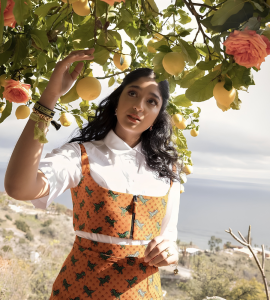
When a girl from Canada with Eelam-Tamil roots — Maitreyi Ramakrishnan playing the role of Devi Vishwakumar — became the face of a new Netflix teen-drama series in 2020, things were about to change for the way the world viewed a South Asian person of color. They were suddenly imperfect, boisterous, and even horny.
The Western idea of what an Indian film looks like, has of course largely to do with glamorous song-and-dance sequences as seen in Sooraj Barjatya and Karan Johar films with star-studded ensemble casts. It’s not that Indian cinema didn’t stand for realism — it did, through the makers of parallel cinema, but that’s a story for another day. The glitzy sherwanis, the bejewelled lehengas and bindis — these are some of the things that travelled to the West, and then were reflected back to us as representation of brown people in American popular culture.
On the other hand, there was the minority-modelesque representation that represented the South Asian populace; those who ran convenience stores, drove taxis, and for the most part, were considered to be hard-working.
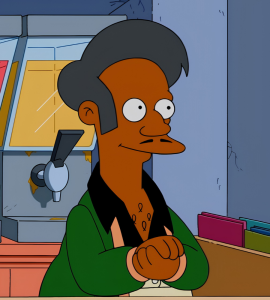
For decades, South Asian characters in American entertainment appeared as doctors, engineers, cab drivers, shopkeepers, terrorists, gurus or awkward immigrants. Their accents preceded their personalities. Perhaps the most notorious and earliest example was that of Apu Nahasapeemapetilon in The Simpsons, the Indian convenience-store owner voiced for many years by Hank Azaria. Apu possessed some admirable qualities — he was intelligent, hardworking and devoted to his family. However, his elongated surname, occupation and accent became an exaggerated representation of the Indian identity. For a generation of South Asian American children, he was among the very few Indian characters visible on mainstream television. Comedian Hari Kondabolu’s documentary The Problem with Apu demonstrated how the character’s voice and catchphrases migrated from television into school corridors, where they became tools of racial mockery. The actor Kal Penn quipped in an interview that he hates Apu, and as a result didn’t like The Simpsons.
Let’s move on to The Big Bang Theory. The reverie begins with Raj Koothrappali staring at Bernadette, his best friend’s girlfriend. Suddenly, the show makes room for a spectacular Bollywood-style dream sequence. Raj and Bernadette bob their heads back and forth and side to side, surrounded by dancers, singing a love song which includes declarations such as “you are my heart, my universe.” There’s even an analogy that compares romantic desire and a trumpeting wild elephant! It is colourful, theatrical and undeniably funny. Yet the sequence also encapsulates how American popular culture frequently imagined India: as a place of elephants, ornamentation, musical extravagance and unrestrained melodrama.
Raj, played by British-Indian actor Kunal Nayyar, was one of the most visible Indian characters on American television during the late 2000s and 2010s. An astrophysicist at Caltech, he initially appeared to break older moulds. He was neither a taxi driver nor a convenience-store owner, but a highly educated scientist. Nevertheless, much of his comedy was built around another familiar construction of the Indian man: intelligent and professionally accomplished, yet socially awkward, emasculated and undesirable. During the early seasons, Raj experienced selective mutism that left him unable to speak to women unless he had consumed alcohol. His friendships with women were often treated as evidence of his femininity.
Raj’s conversations with his strict parents over video calls created another easily recognizable image: the South Asian adult with no autonomy, controlled by their overbearing family. His parents monitored his finances and interfered in his search for a wife, even arranging potential matches for him. These situations reflected realities that some viewers from India could recognize, including close intergenerational relationships and parental involvement in marriage. Yet when these features were combined with his sexual awkwardness and his gullible nature, Raj appeared less like an individual, and more like a collection of attributes America had already learned to associate with Indian immigrants.
If we were to pay attention to the comedian Zarna Garg’s material for her stand-up shows, she would likely bear many of the regressive traits associated with Raj’s parents, including includes her disdain towards her children pursuing creative avenues or dating without their parents’ permission.
Even supposedly affectionate representations frequently relied on Orientalism. India could be admired, but as an exotic storehouse of spirituality, colour and sensuality. Yoga, meditation, henna, bindis, gods, elephants and vaguely ‘Eastern’ music could all be detached from their histories and rearranged into an instantly recognizable aesthetic. In Crazy Ex-Girlfriend, the musical number “I’m So Good at Yoga” features Valencia boasting about her physical and spiritual superiority while performing against an extravagantly “Indian” backdrop. The song is satirical: it mocks vanity, cultural consumption, and the Western transformation of yoga into a competitive lifestyle product. But the comedy still continues to draw upon the audience recognizing a bundle of Orientalist tropes.
There were, however, important attempts to introduce specificity into mainstream television. In 2006, Mindy Kaling wrote “Diwali,” an episode of The Office in which Kelly Kapoor invites her colleagues to a community celebration. The episode brought an Indian festival into an enormously popular American sitcom without making the occasion completely solemn or instructional. Michael Scott predictably misunderstands the celebration, comparing it to an “Indian Halloween” and performing an embarrassing song about Diwali. His ignorance, rather than the festival itself, becomes a joke. “Diwali” was significant precisely because it situated Indian culture within ordinary American life, and is now a state holiday in some states! The celebration takes place in a school gymnasium, populated by families who eat, gossip, dance, and attempt to arrange their children’s romantic futures. Kelly is neither a cultural ambassador nor an idealized South Asian daughter. She is shallow, dramatic, fashion-conscious and deeply entangled in a dysfunctional relationship with Ryan. White characters had long enjoyed permission to be foolish, selfish or strange without the burden of representing their entire race. Kelly’s presence suggested that a South Asian character might eventually receive the same freedom. The gradual expansion of South Asian creative power behind the camera has therefore mattered as much as visibility on screen.
Kaling’s later series The Mindy Project placed a South Asian American woman at the centre of a romantic comedy. Mindy Lahiri was professionally successful, romantically ambitious, selfish, funny and desirable. She did not exist to explain India to white audiences. Likewise, Aziz Ansari’s Master of None explored family, immigration and intergenerational differences through characters whose parents had histories and interior lives of their own. Kal Penn moved between broad comedy in Harold & Kumar and the more serious immigrant-family drama of The Namesake. These works widened the range of possibilities.
More recent productions have gone further. Never Have I Ever places Devi Vishwakumar, an Indian American teenager, at the center of a coming-of-age story about grief, desire, friendship, family and ambition. It has also made Maitreyi Ramakrishnan a very recognizable face in American popular culture. Her character, Devi, makes terrible decisions. She is angry, sexually curious, competitive and sometimes profoundly unlikeable. But these qualities are evidence of narrative equality: she is permitted the complexity routinely granted to white teenage protagonists. The series also delves into her mother’s relationship with India and her cousin Kamala’s negotiations with family expectations.
In Ms. Marvel, Kamala Khan, played by Iman Vellani is Pakistani American, Muslim and a superhero. Her cultural identity shapes the story, but she’s not there for the sake of diversity alone. The series incorporates Urdu, family humour, mosque life, Pakistani popular music and the historical trauma of the 1947 Partition.
Shows such as Bridgerton have offered another kind of intervention by positioning South Asian women as romantic heroines within genres that historically excluded them. Simone Ashley’s Kate Sharma is not merely present in the background of Regency society. She is desired, pursued and is the cynosure of all eyes within the ostentatious backdrop that is so characteristic of Bridgerton’s visual world. Such casting challenges some of the most lingering tropes associated with characters like Raj or Apu; the assumption that South Asians may be intellectually capable or comically viable, but are not capable of embodying glamour, sexuality or romantic longing.
Progress, however, should not be mistaken for an ideal scenario. A brown character should be able to fall in love, remain single, behave selfishly, make mistakes, turn into a hero who saves the day or just disappear, if they wished to. Perhaps this enhancement in the representation of South Asians in popular culture, is closely tied to the rise of political leaders who also are flagbearers of South Asian representation — when we look at the likes of Kamala Harris, Nikki Haley, Vivek Ramaswamy and the current mayor of New York City, Zohran Mamdani! Representation reaches a certain level of completion when South Asians are no longer required to appear in stereotyped roles with strong accents while performing spiritual wisdom or achieving professional excellence. They can simply appear as themselves.




Leave a Reply