

There is something almost suspiciously wholesome about the recent rise of birding. The fact that people are putting down their phones and lifting up their eyes to the skies, to catch a fleeting glimpse of a winged traveler? The fact that instead of waking up and immediately doomscrolling, people are waking before sunrise for a stroll in their local park? The idea that Instagram is passé and binoculars and cameras are in? Wholesome.
Birdwatching now has the world in its claw. An activity once condescendingly seen as a retiree’s hobby is now firing the fancy of millennials, Gen Z and Gen X. It’s now cool to post bird photographs and videos, to recognize the call of the neighborhood nightjar, to follow the birder podcasts. It’s cool to stand under a tree for hours, arms akimbo and binoculars at the ready, eyes straining for a flash of blue or a flutter of fuchsia.
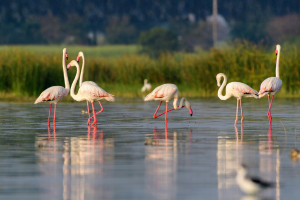
Surveys show that across the UK, nearly 750,000 people aged 16 to 29 now regularly watch birds, an increase of 1,088 per cent since 2018. Across the seas in the United States, nearly one in three Americans now participate in some form of birdwatching.
It’s likely that none of this would have happened without the spurring on of technology. The Merlin Bird app is especially popular. Developed by Cornell University’s Lab of Ornithology, the app simply needs a user to upload a photograph or record the call of an unseen bird, which it then uses to pinpoint the exact species. Similarly, the eBird app makes notes of all sightings, maintains personal lists and reveals what has recently been seen in particular places, by the birder community. MYNA, or Mapping Your Neighbourhood Avifauna, explores bird data across districts, protected areas, localities and custom boundaries. In this way, birding has become an intrinsic part of a vast citizen-science database.
The Great Backyard Bird Count is a sort of citizen census, drawing upon volunteers to submit checklists of feathered friends; India, amongst the most enthusiastic participants globally, submitted nearly 65,000 checklists from more than 27,000 hotspots, recording around 1,093 species. In quite the same way, Bird Count India works with citizen scientists to turn everyday observations into useful ecological information.
Equally accessible are the bird podcasts flooding the e-airwaves. The actor Sean Bean’s Get Birding With Sean Bean might be the most popular one simply by virtue of his career, but in India, Bird Nerds and Bird Podcast with Shoba Narayan are the podcasts that help bring birding into the average home. Bird Nerds explores Indian birds through their calls, habitats, behaviour and peculiarities, while Narayan’s podcast has focused on Indian species and the conservation challenges surrounding them.
Although it may appear that India’s birding culture is tech-focused and therefore rather new, bird enthusiasts have existed for centuries, stretching as far back as the Mughals, who were known to be keen observers of the natural world.
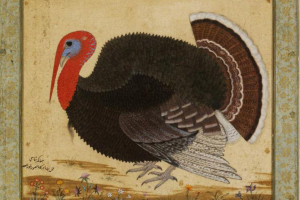
India’s interest in birds predates modern apps and social media by centuries. Emperor Jahangir was,perhaps the most interested of all, commissioning detailed paintings of birds. At one point, an official even presented him with a turkey purchased in Goa from Portuguese traders – a painting was immediately commissioned, and exists to this day. Jahangir, besotted, wrote a long description of the bird.
“One of the animals was larger in body than a peahen and significantly smaller than a peacock. Sometimes when it displays itself during mating it spreads its tail and its other feathers like a peacock and dances. Its beak and legs are like a rooster’s. Its head, neck, and wattle constantly change color. When it is mating, they are as red as can be—you’d think it had all been set with coral. After a while these same places become white and look like cotton. Sometimes they look turquoise. It keeps changing color like a chameleon. The piece of flesh it has on its head resembles a cock’s comb. The strange part about it is that when it is mating, the piece of flesh hangs down a span from its head like an elephant’s trunk, but then when it pulls it up it stands erect a distance of two fingers like a rhinoceros’ horn. The area around its eyes is always turquoise-colored and never changes. Its feathers appear to be of different colors, unlike a peacock’s feathers.”
Emperor Jahangir, in other words, was a consummate birder.
After him came a litany of colonial ornithologists, who were instrumental in recording India’s avian heritage (then hunting it out of the skies). But most crucial to modern Indian birding was the Birdman of India, Salim Ali, ornithologist par excellence. His work with the Bombay Natural History Society and his pivotal 1941 The Book of Indian Birds, showed an entire generation that birdwatching could be a fun and accessible pursuit.
It certainly helps that India has an extraordinarily varied geography, each with its endemic flora and fauna. Equally enthralling is the fact that every year, migratory birds arrive from Central Asia and Europe, transforming wetlands, grasslands and coastlines into temporary gathering places for species travelling thousands of kilometres. Every year in Mumbai, for instance, a gush of pink flamingos settle in Mumbai’s creeks, drawing a flock of round-eyed visitors.
And this is the big magnet then. That a casual birdwatcher can just stand about at their window, go to the nearby park, walk down the street or sit in their building compound to work their hobby. It requires no great brain power, no feats of physical skill. Au contraire, the avid birder can choose to travel to any number of bird destinations such as Keoladeo National Park in Bharatpur, Gujarat’s Nalsarovar and Thol, the wetlands of Kerala, the Western Ghats, the Himalayan foothills and the forests of Central India. All they would need are a pair of binoculars, and / or a camera.
Nature tourism has cottoned on quick. An entire economy is now shaping up with guided walks and trekking companies, wildlife lodges and photography groups, podcasts and informal birding communities. Pugdundee Safaris, for example, offers a five-day Joy of Birding: Beginners Foundation Course at Kanha Earth Lodge, introducing participants to field observation, bird calls, behaviour and habitat interpretation.
The internet has conditioned us to expect something new every few seconds. Birding operates differently. You might spend ten minutes watching a tree before anything appears. Sometimes the reward is a rare species. Sometimes it is simply learning to recognise a call you had never noticed before.





Leave a Reply