

For those of us who grew up reading, the idea of reading as performance is ludicrous. Writers standing on a soapbox and reading from their texts for a rapt audience? Of course. Reading as part of a book club? That is to be expected. But for the rest of us, we picked up a book, sat in a park, and just got on with it.
So why is social media now castigating us for reading publicly? Are we meant to hunch under the covers and read with a flashlight, scurrying away if someone perchance discovers us? Reel upon reel unravels on our timelines, and thinkpiece after thinkpiece satirizes the curious affectations of the performative reader.
This particular accusation is born of a very particular moment in time.
On the one hand, Booktok and Bookstagram has flared interest in books. In the UK, romance, romantasy and speculative fiction sales rocketed up by 6% in 2025, thanks in large part to Booktok. Simultaneously, literary tourism is swelling, with reading retreats one of 2026’s biggest travel trends. This includes everything from traveling to real-world locations from novels, touring writers’ homes and museums, joining literary walking tours, attending book festivals, booking multi-day ‘readaway’ retreats, hunting down beloved independent bookshops, and traveling with book clubs. Every celebrity worth their salt has started a book club, including Emma Watson and Reese Witherspoon. Dua Lipa’s newsletter often includes recommendations for books she has enjoyed.
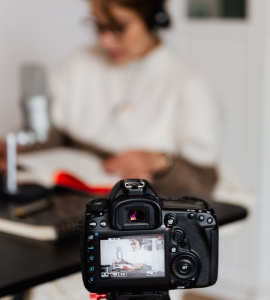
On the other hand, we are told ad nauseum that reading rates have plummeted. North America is facing unprecedented levels of illiteracy; federal data reveals that the thought of reading a book for pleasure is abhorrent to most of us. Attention spans are hurtling rapidly downwards, losing out in the face of gaming and (you guessed it) social media. For some of us reading this, our attention might have already atrophied, our eyes pulled away towards the latest reel offered by Instagram’s canny algorithm.
But what if the reel is about reading? About books? A reel about someone reading books? Surely that can only be a good thing?
Amongst the accusations leveled at performative readers is the insincerity, the idea that they are reading not to enrich their own selves but as an appeal for social validation; reading as a flex, if you will. It’s impossible to argue with this when you read reports of Gwyneth Paltrow hiring book curators to choose books to fill her bookshelves.
Simultaneously, we are inundated with pieces about color-coding your library; Caroline Bullough, chief sub-editor, at UK’s House and Garden has gone on record to say, “I love the sense of order that comes from colour-coded shelves arranged by book size. Things started well when we moved into this house. A neat row of orange Penguin fiction, another of blue Penguin factual, one shelf of small white paperbacks above one of larger white, and a carefully arranged shelf of hardbacks in their crisp, colourful covers graduating from lightest to darkest…”. At the other end of the color spectrum, the author Hanya Yanagihara has been quoted in the Guardian as saying “Anyone who arranges their books by colour doesn’t truly care what’s in the books.”
Reading is meant to be an intellectual activity, expected to enrich one’s empathy, transporting the reader to different times, cultures, lifestyles; it is a smart person’s hobby, one that bolsters our memory, interiority and critical thinking powers. The advantages of reading have been dinned into us all our lives. Using books as a prop, or reading as a purely aesthetic activity curdles all of that.
The strong suggestion made here also is that certain books are seen as pretentious or too mainstream. Is a reader lugging around Dostoevsky’s Notes From the Underground or Sartre’s Being and Nothingness being performative? Can the same accusation be levelled at someone reading Chetan Bhagat’s One Night at the Call Center: A Novel? If the answer is no, then we may need to scrutinize why we place certain books on a public pedestal, and sequester others away for a private read.
This critique also follows in the wake of a slew of reports that social media’s attention is tilting away from perfectly coiffed and made-up influencers to content creators with deep knowledge in their fields, whatever those may be. These creators are bricking a brand around themselves by simply talking passionately about the most erudite subjects that they have spent years studying and working on. Nothing is staged for the ‘gram, and their looks are besides the point; their brains are.

Whichever end of the discussion you stand on though, it’s undeniable that the same platforms that we eye askance are also responsible for pulling book-talk into the mainstream in a way that niche literary magazines never could. That it flattens as well as promotes is unsurprising. But if this is the way to get new readers in the door, it’s a price worth paying.




Leave a Reply