

Chess is one of the rare competitive arenas in which men and women play under exactly the same physical conditions — no height advantage, no difference in muscle mass, no question of endurance. There are sixty-four squares and, theoretically, an equal opportunity to master them. And yet women remain dramatically underrepresented at the highest levels.
India offers an intriguing counterpoint — because India is not simply a country that plays chess. It is the country that gave the world chess in the first place, and it is now producing a generation of women who are beginning to claim that inheritance for themselves. Koneru Humpy, Harika Dronavalli, R Vaishali and Divya Deshmukh are all elite players, their steepling achievements driving them to international fame as Chess Grandmasters.
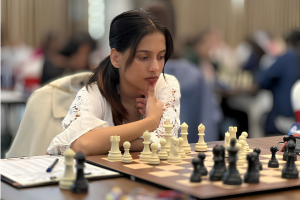
In 2025, something startling occurred. The 19-year-old Deshmukh battled the 38-year-old Humpy over the chessboard in the final of the FIDE Women’s World Cup. The symbolism was unmistakable. Not only were two Indian women facing each other in a global final, they were doing it over a game that was invented in their own country.
The game India gave away
For of course, India has always been chess’ first home. If you unspool it back to its earliest avatar, you’ll likely end up at chaturanga, a game that emerged in India around the sixth century. The name was a reference to the four divisions of an Indian army — infantry, cavalry, elephants and chariots — which eventually became the pawn, knight, bishop and rook of modern chess. Chaturange trundled onwards to Persia (today’s Iran), where it was christened with the name shatranj, before (eventually) moving on to Europe.
Certainly, the game was changed as it moved onwards in the world, but its geometries remained the same. A warlike board game that could be marshalled as easily by male as well as female players.
Humpy became India’s first female grandmaster and one of the strongest women players in the world. Harika Dronavalli established herself among the elite. Vaishali followed, becoming one of India’s newest women grandmasters. Then came Deshmukh, Vantika Agrawal, Savitha Shri B, Padmini Rout, Nandhidhaa PV, Bhakti Kulkarni and Tania Sachdev. The list of names grew and grew.
The Beth Harmon problem
In 2020, something changed. Netflix put on a show about a fictional young chess prodigy – The Queen’s Gambit – an orphan who floats up the world of chess competitions. The twist in the tail? The orphan was a girl, Beth Harmon.
After the show aired, online searches for ‘how to play chess’ soared. The series was watched by sixty-two million households in its first twenty-eight days. Most significantly, Harmon is shown to be the smartest person, easily slicing her way past (male) opponents.
Yet, at the same time, The Queen’s Gambit exposed the distance between representation and reality. Judit Polgár, the Hungarian grandmaster who became the only woman ever to enter the world’s top ten, pointed out that her own experience revealed that her male opponents were considerably less gracious than those on the show.
What makes a chess queen?
Similarly, even in India, two truths co-exist. The pool of talent has widened, thanks to digital access to the game, and increasing school tournaments. State and national academies now foster more young girls entering competitive circuits.
And yet the women’s chess boom in the country is not always representative of its grassroots reality. Don’t be fooled by the scroll of female names; India’s own Gender Equality in Chess Index has highlighted gaps in female participation, resources, representation and institutional support, with calls for stronger grassroots programs, better funding and coaching for women, more women coaches, and greater female representation in chess administration. India has 91 Grandmasters and more than 120 International Masters, yet a mere handful of these are women.
The first task, therefore, is not to find more prodigies. It is to widen the funnel — school chess clubs treated as ordinary rather than extracurricular, accessible tournaments outside the major cities, affordable coaching, and families who see women’s chess as a legitimate pursuit.
At the same time, women need greater access to strong competition. Humpy has made this point herself — women’s chess has become significantly more professional, but women-only tournaments can limit young players’ opportunities to compete against the strongest men (for no lack of intelligence). Separate tournaments have their own indubitable advantages but those spaces might soon become claustrophobic.
A different kind of inheritance
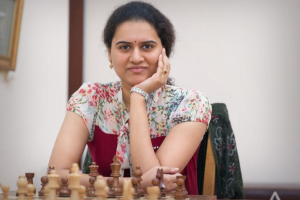
India’s relationship with chess has come full circle. A game that began, in one of its earliest forms, as a representation of an army has travelled through kingdoms and empires, across continents and languages, into computers and phones — and back to the country that first imagined it. Humpy helped establish that Indian women could build professional lives around a game their own civilization had invented. Deshmukh and Vaishali are now showing what happens when that possibility becomes normal.
The most important transformation may not be the number of medals Indian women win. It may be the number of girls who see a chessboard and don’t see an obstacle; they see an opportunity.





Leave a Reply