

India is a country where a single playlist can get all states nodding along to the same song. Walk into a nightclub in Mumbai or a college fest in Kochi, and the odds are decent that at some point the DJ will reach for the latest Punjabi bop. What’s more, audiences will probably demand it.
Even though Punjabi is the mother tongue of merely 2.74% of Indians, it has flooded the country’s playlists and Diljit Dosanjh is likely the reason why. He is the first Punjabi artist to play Coachella, and has collaborated with Sia and Camilo; such cross-pollination has helped knuckle Punjabi music into the global mainstream. Karan Aujla represents the next wave, matching hip hop to bhangra, reflecting the country’s global aspirations and growing confidence in the world. Western music had been seeping into India for decades; recently only though has regional music accepted it with quite so much elan. Between them, the two have turned Punjabi music from a regional taste into one of India’s most successful exports.
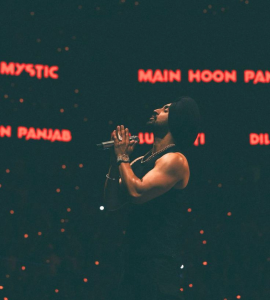
Part of the appeal is portability. Bhangra is a bop! And Indians love to dance; rhythm crosses language barriers more easily than lyrics do. Long before streaming existed, Punjabi songs already travelled through weddings and diaspora networks in the US and the UK; infrastructure that no other regional tradition possessed in quite the same way.
Punjabi pop’s success echoes the trajectory of K Pop, another regional industry that outgrew its borders. It is no accident that young, well-traveled, global Indians meet BTS and Diljit Dosanjh in the very same scroll.
If Punjabi music conquered India’s public spaces, singer-songwriters such as Anuv Jain and King have taken its private ones. Some of the country’s most interesting acts are scattered around India, defying (as P Pop is) the dominance of Hindi music: a rapper from Shillong, an artist from Arunachal Pradesh who slides between English, Hindi and Nyishi in a single song, a Delhi collective that fuses Punjabi folk with metal. Clearly, Mumbai is no longer the heartbeat; the filaments of the music industry have spread, reflecting a growing urbanism away from the major metros. While alternative and indie acts were always part of college festivals and music festivals thanks to MTV and its local equivalent, Channel V, they’d never quite achieved mainstream success. For this, we must thank streaming services that have democratized the music landscape to some extent.
For decades Bollywood accounted for roughly four-fifths of all music consumption in India. Its dominance is waning slowly, its share of the pie slipping to around two-thirds, eaten into by non-filmi streaming platforms and artists. Still, some of this year’s biggest chartbusters came via the film Dhurandhar: The Revenge (released in the last weeks of 2025), a jingoistic mass entertainer that held up a mirror to a masculinist section of Indian society.
The same streaming platforms that broke Bollywood’s monopoly on taste have also proved useful to ideologues. Alongside the love songs and wedding anthems has grown an ecosystem of ‘Hindutva pop’, a genre that does exactly what its name suggests i.e sings about Hindu identity and majoritarian politics reflecting this wider shift in Indian society. This is a genre that is no longer confined to small towns in traditional Central India; it racks up millions of views on Youtube and is even played at official government ceremonies.
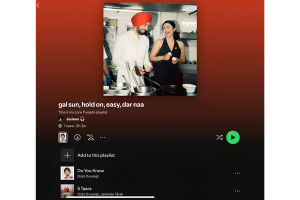
Back at the party, the music plays on. Bollywood songs will remain fixtures of Indian celebration for years yet; cinema is too deeply stitched into the culture to vanish overnight. But the balance has tipped. Indian music increasingly resembles not a single canon curated in Mumbai, but a federation — Punjabi pop, acoustic singer-songwriters, regional rap, ideological anthems — all competing for the same thumb on the same scroll. The center has not disappeared. It has merely lost its monopoly on what the nation hears.


Leave a Reply