

The song playing in the background of the reel is Gujarati folk music. A man is hunched over a white cloth, meticulously sketching miniature figures onto it. And that’s it. This simple Instagram reel has 18.6 k likes, 259 forwards and multiple re-shares and comments.
Who is the man? It is the artist Dilip Chitara in his home at Viramgam, in Gujarat, working on Mata Ni Pachedi, a 400-year-old textile art. His Instagram account has a total of 361 posts and reels. An unremarkable number, except that in 2020, Chitara, a fourth-generation artist was barely making Rs 2,00,000 a year, and today, he makes ten times the amount. His 27-year-old son Ajay, handles his father’s social media account, which has helped him get orders from the US, UK, as well as online and offline stores across India.
There was a time when the Chitaras had no money to fix the leaking roof of their home. Today, they employ 25 women from their village. These women fill the colors in Chitara’s outlines.
“Who knew social media had so much power?” asks Ajay. “We didn’t either until Covid struck,” adds E Rajeshwari, ex-secretary of a craft NGO, The Crafts Council of India.
Social media has helped traditional artisans, even from remote places in India, to connect directly with customers around the world. Instagram, YouTube, and even X have helped them share their work with the world, and educate viewers about their art forms. It’s given them autonomy, financial security, and cut out the middleman. “More importantly, it has helped revive dying arts and crafts, and motivated younger artists to continue their family’s legacy,” says Rajeshwari.
Mata Ni Pachedi involves the meticulous painting of a cloth, a cloth that was once used as a mobile shrine by the indigenous Vaghri community. The Chitaras had practiced it for five generations. But Ajay had almost given up on it just before the Covid 19 pandemic. Instead, he took up a job as the salesman of a company that makes calculators. “I have been painting Mata Ni Pachedi since I was a baby, and never wanted to do anything else,” says the artist. “But it had gotten extremely challenging to sustain the family by just painting, which is why I was forced to take up the job.”
But during the pandemic, when the roof of his house started leaking, Ajay fell back on his art to get funds for repair work. The NGO Kaarigar Clinic suggested that Ajay take pictures of his leaky roof and post them on Instagram alongside his father’s art. The NGO posted these on their social media platforms too. “Help poured in from everywhere,” recalls Ajay. Clients paid money in advance for commissioned pieces. “I realized that I can reach customers from around the world through social media,” says Ajay. He attended social media workshops conducted by NGOs. They taught him how to take good pictures, in good light, how to shoot good videos, make reels and post them.
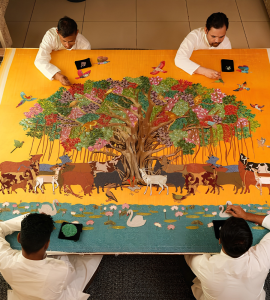
When the pandemic disrupted traditional markets and left artisans struggling, NGOs began teaching craftspeople how to use social media as a sales tool. Among these efforts was a programme led by the Crafts Council of India, which, alongside partner NGOs, trained 5,000 artisans to build an online presence and connect with buyers directly.
Through social media, Ajay learnt to innovate. He urged his father to create hand-made masks, saris and dupattas, with Mata Ni Pachedi motifs. These were then posted online. “I interact with my customers directly now, which has helped me understand what people like and don’t like, and how we must tweak our offerings accordingly.”
In Rajasthan’s Bhilwara, 26-year-old Anuj Joshi also has a similar story. He comes from a family of phad painters. A phad is a hand-painted scroll that illustrates the life of Pabuji, a local Rajasthani deity. Anuj’s father Kalyan is a revered Phad painter, and among the last few remaining artists of the art. “It was under threat. No kids wanted to pursue it as it hardly made any money,” says Anu Sorabji of the artist collective, Paramparik Karigar. Anuj also didn’t. He was inclined towards digital art and worked as a freelance artist for a couple of years. But operating from a small city was not easy.
So, when the Covid 19 slump hit, Anuj decided to help his father and 31-year-old sister Kritika (also a Phad artist). He started posting their work on social media, and orders from the US, UK, Singapore and Hong Kong started pouring in. Kalyan Joshi’s Instagram account now has 67.7 K followers with an average of four orders coming from the platform every month.
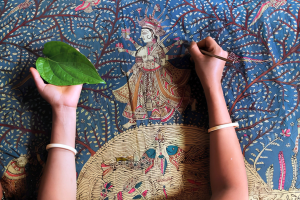
The success has been contagious. Several kids from Bhilwara have signed up for Phad painting lessons from Kalyan. Anuj too has started painting again. “I realised that there are buyers for traditional arts too. One just needs to know how to reach them. Social media has been a great help,” he adds.
Rajeshwari points to similar examples found throughout the country. India’s traditional arts and crafts—numbering an estimated 3,000 forms and ranging from bells and footwear to mats, sculptures, and saris — are now reaching a much wider audience. However, this visibility has a downside: it’s become easier for digital printing businesses to replicate artists’ original designs, then reproduce them on canvas and sell them at cheaper prices, as Anuj points out. There’s also a growing problem of repetitive imagery across different art forms. Sorabji notes that motifs like the ‘tree of life’ now appear everywhere, regardless of whether they originally belonged to that particular tradition. Similarly, Bollywood-themed posters rendered in traditional styles—be it Pattachitra or Phad — have become a common sight.
Even so, the benefits clearly outweigh the drawbacks. Social media is opening a new chapter for how traditional arts are created and sold. At last, these art forms are moving with the times and receiving the recognition they deserve.




Leave a Reply