

One of life’s greatest pleasures? Going to a new restaurant, ordering a glass of Sauvignon Blanc, and a perfectly-poached, butter-fleshed fish cloaked with a citrus sauce. Maybe it comes with a crisp green salad studded with brash tomatoes, ripe with juice. After, perhaps, you order a lemon tart, fresh and bright and zingy. But the best part? The best part is enjoying the meal alone, giving it the attention it deserves, not sharing it, not muddying the meal with inane chit-chatter.
Yet for all its pleasures, dining alone remains a surprisingly radical act in much of the world, and perhaps nowhere more so than in India.
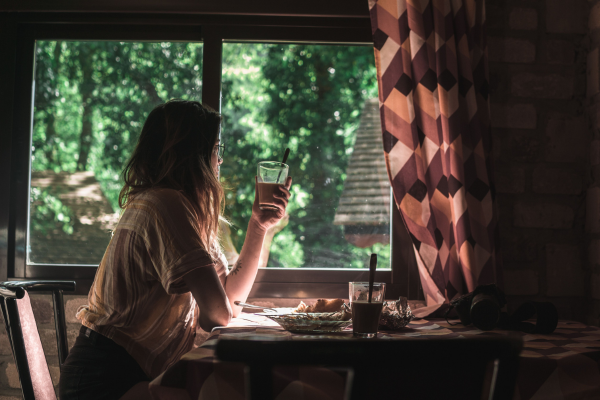
For a country built around the conviviality of the shared meal (think of the Bohri thaal, where families and friends eat out of the same thali), solo diners have long been seen as the exception rather than the norm.
There was always a gendered dimension to this. A man eating alone at a restaurant was often seen as professional and independent. A woman dining by herself, meanwhile, was more likely to attract curiosity or suspicion. The assumption was that public leisure belonged to groups, couples, or families — not to a woman occupying a table alone.
That assumption is slowly loosening its grip, and several forces are driving the change.
Perhaps the biggest driving force is the rise of remote and freelance work. The pandemic knuckled people out of their offices and into cafés and co-working spaces — this helped normalize solo diners, busy with their laptops and phones and Airpods.
Social media has also helped reframe solo dining as a form of self-care and an intentional lifestyle choice rather than an awkward necessity. Instagram is filled with carefully-composed images of a lone wine glass beside a beautifully plated meal, turning solitude into something aspirational.
Layered on top of this is a broader cultural move towards individualism. Millennials and Gen Z are generally more comfortable prioritizing personal preference over group consensus than previous generations. For them, dining alone can be as empowering and relaxing as a yoga class or a slow walk in the park.
Of course, working-class women in India never really needed permission to eat alone in public. Any railway platform, street-food stall, or bus depot tells that story. Women have long grabbed an omelette pao, a plate of pao bhaji, a quick snack before or after shifts. Solo dining itself is not new. What is changing is who gets to do it without attracting attention, and in what kinds of spaces.
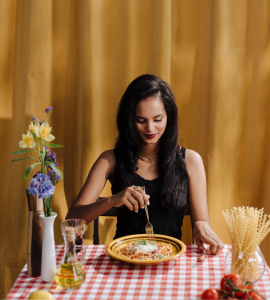
India’s moment mirrors similar developments around the world. In the United States, solo dining reservations have risen steeply by nearly 30% over the past two years. The United Kingdom has recorded similar growth, particularly in cities such as London and Manchester. In Australia, solo reservations increased by 12% in the past year alone, with solo diners spending an average of AUD 94 per meal — roughly 36% more than diners eating in groups.
Restaurants, however, have been somewhat slower to adapt. Most dining rooms in India are still organized around couples or larger groups. Tables for two dominate the floor plan, while the solo guest is often eyed askance; not unwelcome, simply an afterthought.
That may be starting to change. Business owners are beginning to realize that solo diners are easier to accommodate, turn tables more quickly, and, according to certain industry surveys, often spend more per person than group diners. In response, some cafés and restaurants in India and abroad are experimenting with single-seat counters, bar seating, and communal tables that make dining alone feel less like an exception and more like a recognized and respected customer category.
The real question is no longer whether solo diners will find a seat. It is whether the hospitality industry will evolve quickly enough to welcome them.
Because solo dining is not a passing trend. For a growing number of Indians — and especially for women — eating alone is no longer a backup plan reserved for cancelled arrangements or busy schedules. It is a choice. And increasingly, it is the first one they make.





Leave a Reply