Roti begins as something ordinary, made from flour, water, and heat, rolled out quickly, eaten daily, and rarely discussed. Across the Indian subcontinent, it appears at breakfast tables and in packed lunches, folded around whatever happens to be on hand. Its familiarity makes it easy to overlook, yet this flatbread has traveled farther than many of the people who make it, crossing oceans, surviving shortages, and learning how to belong elsewhere.
Around thee world, roti may already feel familiar, even if the name does not. It follows the same logic as tortillas, wraps, and other flatbreads that appear wherever people need food that is portable, affordable, and adaptable, food that works around labor and routine. These breads endure because they bend easily to place, habit, and necessity.
That flexibility became especially important in the nineteenth and early twentieth centuries, when Britain moved more than 1.3 million Indian indentured laborers across its empire after the abolition of slavery. Between 1845 and 1917, roughly 145,000 were sent to Trinidad alone. They arrived with contracts and expectations of return that were often unmet, but what traveled more reliably were habits, particularly those tied to food. Cooking offered a sense of steadiness, and roti required no written recipe, living instead in practice and repetition.
Once abroad, ingredients shifted. Wheat, central to many North Indian rotis, was expensive or scarce in several colonies, so cooks adjusted with what was available. In the Caribbean, that meant lentils, with split peas ground, spiced, and sealed inside dough to create dhalpuri, a stuffed flatbread cooked on hot cast iron skillets and eaten with curries shaped by local produce and climate. In Malaysia, Indian Muslim migrants stretched dough thin, folded it with oil, and cooked it quickly, giving rise to roti canai, food suited to long workdays and eating outside the home, paired with daal or sweetened condensed milk at roadside stalls.
At first, these changes were practical, responses to constraint rather than intention. Over time, however, they settled into preference and pride. Dhalpuri is not remembered in Trinidad as a compromised roti, and roti canai is not treated in Malaysia as a distant echo of India. These foods are argued over, perfected, and claimed as local, shaped as much by taste and habit as by history. What began as adjustment slowly became authorship.
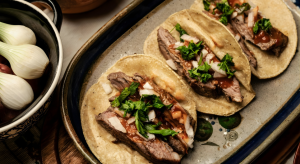
This pattern extends beyond South Asia and its diasporas. Mexico’s tortilla, made from corn rather than wheat, follows a similar principle, a flatbread shaped by land, labor, and daily life. Such similarities are less coincidence and more structure. Flatbreads endure because they adapt, although the conditions that demand adaptation are rarely neutral, shaped instead by movement, constraint, and power.
Indian food does not land the same way everywhere. In London, it often appears behind white tablecloths and tasting menus, introduced course by course. In Trinidad, roti is more likely to be wrapped in paper and eaten at midday, warm and filling. In Kuala Lumpur, it shows up early, ordered with tea, torn by hand at roadside stalls before work begins. The food travels, but its social position shifts as well, shaped by who is eating it, when, and under what conditions.
In many Western dining rooms, those same flavors are recast through the language of refinement. Dishes are described as lighter, cleaner, or more restrained, their histories reduced to brief references or visual cues. What changes is not only how the food tastes, but how it is explained, and who is assumed to be listening. When a British chef sold a £300 butter chicken a few years ago, the reaction was swift, not only because of the price, but because of how easily a dish rooted in Delhi homes and roadside dhabas could be detached from context and presented without reference. On supermarket shelves, boutique spice brands follow a similar logic, where packaging grows sleeker even as questions about sourcing and credit grow louder, particularly as diaspora-led brands push back against who gets to tell these stories.
Global recognition continues to follow familiar routes. Many Michelin-recognized Indian restaurants operate outside India, especially in the United Kingdom, where London alone has several. India itself has none under the official Michelin Guide, which does not operate in the country, reinforcing the sense that prestige often arrives only after Indian food passes through Western institutions.
Borrowing, however, does not move in a single direction. Indian chefs reinterpret French pastry techniques, Japanese matcha, and New York bagels, layering their own histories onto global forms. Adaptation itself is not the tension. The question lies in visibility, in whose origins remain legible and who gets invited into decisions about value and authorship.
The same dish can be received very differently depending on who serves it and where. Restaurants offering “elevated Indian street food” attract attention and awards, while Indian-run dhabas selling similar food rarely do. Part of this gap is structural, shaped by access to capital, location, and publicity, and part of it is aesthetic, as dishes become acceptable once spice is restrained, interiors minimal, and narratives framed for a Western audience.

Even within the diaspora, agreement is far from universal. A Trinidadian dhalpuri does not taste like a Punjabi roti, though both can carry the same emotional charge. Within families and communities, these differences are not always settled. One person holds on to how roti used to be made, another defends the version they grew up eating, even when the ingredients or technique look unfamiliar. Sometimes the roti that feels most like home is the one that would look least recognizable to someone further back in the family line, and that gap can feel hard to explain.
For all its movement and reinvention, roti still belongs to routine. It is rolled out in the morning, a grandmother in Port of Spain brushing flour from her hands, a student in London working around a small stovetop because the taste feels grounding after a long day. For some, making roti repeats something learned by watching. For others, it becomes a place to try things out, to adjust, to make it fit a new life.
Seen this way, roti does not settle easily into a single definition. Folded around curry in Trinidad, stretched and flipped on a Malaysian griddle, or served in a New York dining room, it carries traces of where it has been and who has handled it, changing slightly each time without fully letting go of what came before. What it ultimately reveals is less about purity than process, and the ongoing challenge of ensuring that when it arrives at the table, the hands that shaped it, and the journeys that transformed it, remain visible.
Leave a Reply